
Research: Gillian Schutte
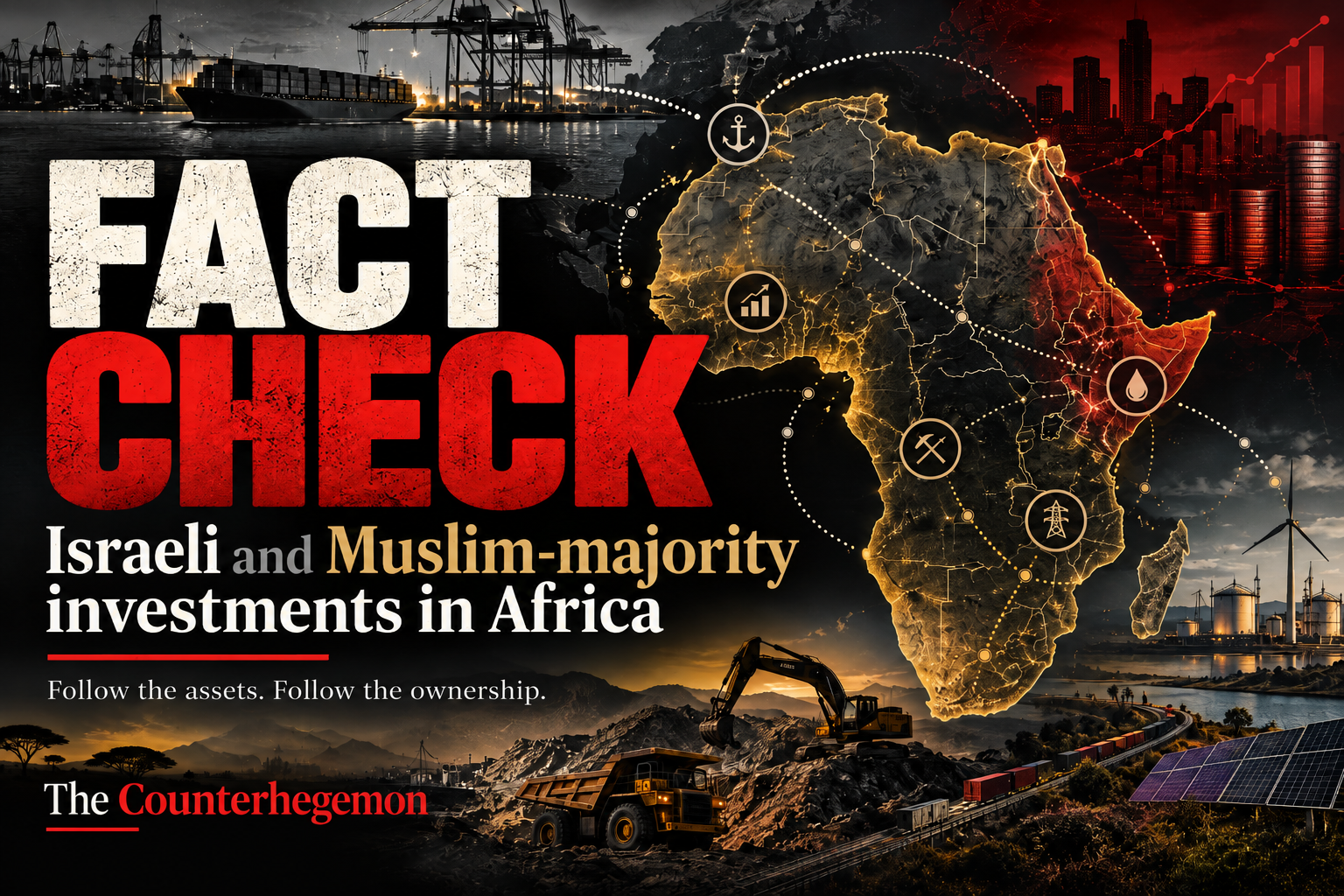
The increasingly heated argument about Israeli economic influence and the alleged “Islamic colonisation” of Africa has generated competing accusations about foreign infiltration, ideological influence and threats to African sovereignty. Yet the term “Islamic” obscures the considerable political, economic and strategic differences between Muslim-majority countries, including the Arab Gulf states, Turkey, Iran, Malaysia and Indonesia.
But what happens when we abandon the slogans and examine the ownership records?
The available figures document a substantial Gulf investment footprint, although they do not establish a like-for-like comparison with Israel. Arab Gulf states have invested more than $100 billion in Africa over approximately a decade, acquiring interests in ports, mines, food production, telecommunications, logistics and energy infrastructure. Turkey, Iran and other Muslim-majority countries pursue their own economic and strategic relationships across the continent.
Israeli-linked commercial interests are also well established, extending into African agriculture, manufacturing, minerals, infrastructure and security technology. However, no comprehensive, directly comparable figure for Israeli investment across the continent has been established.
What makes this picture particularly revealing is that Israel and several Arab states are also commercial partners. Israel and the UAE traded more than $3.2 billion in goods in 2025.
There is also a critical distinction between Israel’s colonisation of Palestinian territory and its economic activities in Africa. The former involves questions of territorial occupation, settlement, sovereignty, international law and genocide. The latter requires examination of corporate ownership, commercial agreements, strategic influence and economic dependency. Conflating these two dimensions risks obscuring the specific mechanisms through which foreign interests operate.
Equally, describing investments originating in Muslim-majority countries as “Islamic colonisation” substitutes religious identity for political-economic analysis. Turkey, Saudi Arabia, the United Arab Emirates, Qatar and Iran pursue distinct national economic and geopolitical interests. Their investment activities cannot be attributed to a single religious agenda. Foreign acquisitions and investments do not automatically constitute colonisation. That assessment requires evidence of domination, coercive control or entrenched structures of dependency.
We have no intention of artificially balancing the figures or protecting any foreign power from examination. The substantial documented investment footprint of the Arab Gulf states does not diminish the significance of Israeli economic and security interests. Equally, Israel’s conduct in Palestine does not exempt governments and corporations from Muslim-majority countries from examination of their economic activities in Africa. The political positions of foreign governments cannot determine the standards applied to their investments, ownership structures and strategic influence.
The investigation applies the same questions to every investor: Who owns the assets? Who controls the resources? Where do the profits go? What influence is acquired through these arrangements? And what remains under African control?
Africa’s economic sovereignty cannot be assessed through competing religious loyalties or imported ideological slogans. The ownership records provide a more concrete starting point.
Let’s examine the facts.
Israeli-linked interests are documented in South African dairy production, Angolan infrastructure financing and African mineral and agricultural projects.
The UAE has acquired logistics companies, mining interests and telecommunications networks, while also operating major African ports.
Saudi state-owned capital controls 80.01% of Olam Agri. Qatar has invested in South African aviation, Southern African mining and Rwandan airport infrastructure. Turkish companies operate in African manufacturing, steel production, airports and electricity supply.
Israel and the UAE also maintain substantial bilateral trade.
The central questions are economic: who owns the assets, who receives the revenue, who controls the contracts and what benefits remain in Africa?
THE COUNTERHEGEMON | AFRICA INVESTMENT FACT CHECK
How much African industry, infrastructure and natural wealth is held or financed by Israeli-linked, Arab Gulf and other Muslim-majority interests?
The figures below distinguish completed takeovers, existing shareholdings, infrastructure contracts, credit facilities and proposed investments. These represent different forms of economic involvement and cannot all be added together.
1. Israel and Israeli-linked interests
| African country | Company, asset or project | Published amount or scale |
|---|---|---|
| South Africa | Clover Industries, acquired by Israeli-led Milco consortium, 2019 | R4.8bn acquisition |
| Angola | Luminar Finance/Mitrelli infrastructure-financing framework, approved 2023 | $2.7bn approved financing |
| Angola | Lobito Corridor platform with Israeli businessman Haim Taib, 2025 | $50m Israeli-linked commitment, matched by $50m from Angola |
| Angola | Aldeia Nova agricultural development, beginning 2003 | $70m historical project cost |
| Angola | Quiminha agro-industrial development, contracted to Israeli Tahal Group | $200m–$370m reported contract value |
| Côte d’Ivoire | Green 2000 agricultural production and training developments | $120m project financing |
| Rwanda | Gigawatt Global solar farm, developed with Israeli affiliate Energiya Global, 2015 | Approximately $24m project |
| Sierra Leone | Koidu diamond mine, established by Israeli businessman Beny Steinmetz’s BSG Resources | Historical ownership; value not reliably established |
| DR Congo | Dan Gertler/Fleurette mining and petroleum concessions | Approximately $2bn in assets identified in a 2022 recovery agreement |
| Nigeria, Uganda, Kenya, Ghana, Tanzania, Côte d’Ivoire, Benin and Togo | Israeli infrastructure company Shikun & Binui | Documented corporate presence; no verified consolidated investment value |
Source verification and qualifications:
The Angolan government confirmed its approval of the $2.7 billion financing arrangement with Luminar Finance, linked to Israeli businessman Haim Taib’s Mitrelli group. This is a financing framework for projects, not evidence that the entire amount has already been disbursed.
The Aldeia Nova, Quiminha and Côte d’Ivoire figures are documented in agricultural research organisation GRAIN’s investigation of Israeli agricultural projects. These were substantially African-government-financed contracts, rather than Israeli equity acquisitions.
Reuters documented the proposed recovery of approximately $2 billion in mining and oil assets from companies linked to Dan Gertler in 2022. This is an asset valuation, not an investment payment, and the assets cannot simply be counted as current Israeli holdings.
Shikun & Binui itself lists operations in eight African countries. The Swiss-headquartered Mitrelli group lists projects in Angola, Côte d’Ivoire, Mozambique and Senegal. Both have Israeli business connections, but their legal structures must be distinguished from direct investment by the State of Israel.
Koidu’s operations were suspended during a labour dispute in 2025. Its historical Israeli ownership is documented, but this does not establish a currently operating mine or a reliable present-day ownership valuation.
The available disclosures establish extensive Arab Gulf and Turkish corporate networks across Africa. Their scale, ownership structures and financial commitments demand examination, although the absence of directly comparable Israeli investment totals prevents a definitive quantitative ranking.
2. United Arab Emirates — ports, telecoms, mines, logistics and energy
The UAE’s holdings extend well beyond Imperial Logistics. They include African telecommunications networks, mining companies, power stations and strategic port concessions.
| Country | Asset or investment | Value, ownership or commitment |
|---|---|---|
| South Africa | Imperial Logistics — DP World | R12.7bn takeover, 2022 |
| South Africa, Egypt, Senegal | Lekela Power wind portfolio — Masdar/Egyptian Infinity joint venture | 100% platform acquisition, 2023; approximately 1 GW of operating wind capacity |
| Morocco | Maroc Telecom — UAE telecoms group e& | 53% controlling stake |
| Egypt | e& Egypt, formerly Etisalat Misr | 66.4% ownership |
| Benin, Burkina Faso, Central African Republic, Chad, Côte d’Ivoire, Gabon, Mali, Mauritania, Niger and Togo | Maroc Telecom’s African subsidiaries | Indirect Emirati corporate ownership through Maroc Telecom |
| Morocco | TAQA Morocco, electricity generation | 85.79% UAE ownership |
| Ghana | Takoradi International Company, electricity generation | 90% TAQA ownership |
| Zambia | Mopani Copper Mines | 51% acquired; up to $1.1bn financing package, 2024 |
| DR Congo | Alphamin Resources, operator of Bisie tin mine | 56% acquired for approximately $367m, 2025 |
| Mozambique | Maputo container-terminal expansion — DP World | $600m investment programme |
| Somaliland | Berbera port — DP World | Up to $442m committed, under a long-term concession |
| Senegal | Dakar container terminal — DP World | Existing port concession |
| Senegal | New Ndayane deep-water port — DP World | $1.2bn project, construction under way |
| Tanzania | Dar es Salaam — DP World | 30-year port concession, with initial investment exceeding $250m |
| Angola | Luanda multipurpose terminal — AD Ports | Approximately $250m committed; 20-year concession |
| Republic of Congo | Pointe-Noire New East Mole terminal — AD Ports | 30-year concession, with an initial $220m capital programme and a larger long-term investment framework |
| Egypt | Safaga port — AD Ports | $200m committed capital expenditure |
| Rwanda | Kigali Logistics Platform — DP World | $35m development, 25-year concession |
| Egypt | Ras El-Hekma development — ADQ | $35bn agreement, including $11bn in converted deposits |
The telecommunications holdings are particularly significant. UAE company e&’s 2025 annual report establishes its majority positions in Maroc Telecom and its Egyptian operation. Maroc Telecom’s African subsidiaries extend the group’s economic presence across West and Central Africa.
These are operating companies with established customer bases, infrastructure, commercial contracts and recurring revenues. Their presence cannot be captured by listing only individual investment announcements.
AD Ports’ investor disclosures identify its African concessions, shareholdings and capital commitments, while DP World’s corporate statements confirm the Maputo, Berbera, Ndayane and Kigali projects.
IRH confirmed that it completed the 56% Alphamin acquisition in July 2025. Masdar confirmed that the UAE–Egyptian Infinity Power venture completed its acquisition of Lekela Power in March 2023.
Ownership qualification: The UAE does not own these African countries’ ports or entire electricity systems. Corporate majority stakes, operating rights and long-term concessions provide defined economic rights. The underlying assets and public regulatory powers may remain with African states.
3. Saudi Arabia — food production, electricity and water
| Country or region | Asset or project | Value or ownership |
|---|---|---|
| Africa-wide, including Nigeria and South Africa | Olam Agri — SALIC | 80.01% controlling stake, completed April 2026 |
| Global transaction with extensive African operations | Olam Agri additional share acquisition | $1.88bn paid in 2026 |
| South Africa | Redstone solar thermal plant | $876m total project cost; ACWA Power holds an effective 36% |
| Morocco | Noor Ouarzazate I solar project | $841m project cost; ACWA Power 73.1% |
| Morocco | Noor Ouarzazate III | $942m project cost; ACWA Power 75% |
| Egypt | Kom Ombo solar power plant | $163m project, 100% ACWA Power ownership |
| Egypt | Suez wind-energy development | Approximately $1.1bn–$1.2bn in published phase-one financing and investment arrangements, subject to the project’s financing structure |
| Senegal | Grande Côte desalination project | Approximately $800m proposed investment, under a renegotiated agreement signed in 2025 |
Saudi Arabia’s Olam Agri acquisition reaches well beyond a single African country. It adds agricultural commodity processing and distribution businesses across numerous African economies to a Saudi state-owned investment portfolio. The company itself confirms the completed 80.01% stake.
ACWA Power’s corporate project documents give the plant costs and ownership figures for its Moroccan, Egyptian and South African operations. The Kom Ombo installation entered commercial operation in 2024.
The Senegal agreement requires a separate clarification. The original $800 million contract was rejected by the incoming Senegalese government in 2024, which objected to its costs. A renegotiated agreement was subsequently signed in July 2025 with more favourable provisions for Senegal. It would be misleading to describe the original 2024 agreement as having proceeded unchanged.
Project costs include debt, equity and sometimes multiple investors. They are not equivalent to the Saudi shareholder’s direct cash contribution.
4. Qatar — aviation, airports, copper, platinum and offshore energy
Qatar’s interests extend into South Africa’s aviation and mineral sectors, as well as oil and gas exploration in several African countries.
| Country | Asset or investment | Amount or ownership |
|---|---|---|
| South Africa | Airlink — Qatar Airways | 25% acquired for QAR149m, approximately $41m |
| South Africa and DR Congo | Ivanhoe Mines — Qatar Investment Authority | $500m completed investment, approximately 4% equity stake |
| South Africa | Offshore Block 3B/4B | 24% proposed QatarEnergy interest, subject to the relevant approvals |
| South Africa | Deep Water Orange Basin offshore exploration | 30% interest reported in 2024 |
| Rwanda | New Kigali International Airport | 60% held by QIA, following a $578m acquisition from Qatar Airways |
| Rwanda | Additional airport construction financing | $1.1bn Qatari commitment |
| Namibia | Offshore Block 2913B/PEL56 and Block 2912/PEL91 | Additional participating interests agreed in 2024 |
| Namibia | Offshore Block 2813B/PEL0090 | 27.5% participation agreed, 2024 |
| Republic of Congo | Nzombo offshore exploration block | 35% QatarEnergy participation, awarded 2025 |
| Egypt | North El-Dabaa offshore block | 23% participating interest agreed, 2024 |
| Egypt | North Cleopatra offshore block | 27% acquisition agreement, 2025 |
| Mozambique | Offshore exploration blocks | Historical QatarEnergy interests, documented in earlier annual reports |
| Kenya | Lamu Basin offshore exploration | Historical 25% QatarEnergy participation, documented in earlier annual reports |
The Ivanhoe transaction is revealing. In September 2025, QIA completed a $500 million share purchase in the Canadian mining company, whose principal African projects include the Kamoa-Kakula copper complex and Kipushi mine in the DRC and the Platreef project in South Africa.
QatarEnergy’s annual reporting confirms its offshore African portfolio, while the Republic of Congo licence was announced in September 2025. Some historical exploration licences have subsequently changed or expired, so earlier holdings cannot automatically be treated as current.
The Rwanda airport acquisition and further construction commitment are confirmed by QIA’s announcement of 1 June 2026. The $578 million transaction was a transfer between Qatari entities, rather than entirely new foreign capital entering Rwanda.
5. Turkey — steel, manufacturing, aviation, ports and electricity
Turkey is a Muslim-majority country, although it is neither Arab nor part of the Gulf Cooperation Council.
| Country | Company or project | Investment or commercial position |
|---|---|---|
| South Africa | Defy Appliances — Arçelik | $327m completed acquisition, 2011 |
| Algeria | Turkish industrial investments, including Tosyalı steel manufacturing | Approximately $8bn reported by Turkish authorities, end-2025 |
| Egypt | Turkish manufacturing and industrial businesses | Approximately $4bn in reported Turkish investment |
| Ethiopia | More than 200 Turkish enterprises | Approximately $2.5bn in reported investment, 2026 |
| Senegal | Blaise Diagne International Airport — Limak/Summa consortium | 25-year operating concession; Turkish partners originally held 66% jointly |
| Niger | Diori Hamani International Airport — Summa | Turkish airport operating and development involvement |
| Sierra Leone | Freetown International Airport — Summa | Turkish airport investment and operating involvement |
| Somalia | Port and aviation operations in Mogadishu | Turkish commercial operating interests |
| Ghana | Floating electricity generation — Karpowership | Long-term power-supply contracts |
| Senegal, Côte d’Ivoire, Guinea, Gabon, Sierra Leone, Mozambique and other markets | Karpowership floating power installations | Documented project activity, with contracts and operating periods varying by country |
Turkish official disclosures report investment of approximately $8 billion in Algeria and $4 billion in Egypt by the end of 2025. President Erdoğan also reported $2.5 billion in Turkish investment in Ethiopia in February 2026. These nationally reported figures may use different measurement methods from international FDI statistics.
For airport infrastructure, Senegal’s airport authority identifies Turkish companies Limak and Summa as investors in Blaise Diagne airport’s operating company. Turkish company Summa also lists airport operations in Niger and Sierra Leone.
Karpowership provides an extensive example of influence through electricity-supply agreements. Its corporate project directory lists operations and past projects in several African countries. These are power-generation contracts, rather than outright acquisitions of national electricity systems.
Turkish sources also report more than $97 billion in African construction-contract value across over 2,000 projects. That is a measure of work undertaken, not foreign direct investment or ownership of African assets.
6. Kuwait, Indonesia, Malaysia and Iran
The classification cannot end with the Arab Gulf states and Turkey if the intention is to include economically active Muslim-majority countries.
– Kuwait — Sudan and South Sudan: Kuwait-headquartered Zain Group’s 2025 accounts disclose 100% ownership of Zain Sudan and Zain South Sudan. Its African telecommunications operations form part of a wider regional network.
– Indonesia — Algeria: Indonesian state-owned Pertamina holds oil-sector interests in Algeria. Its renewed production-sharing agreement for Block 405A envisaged more than $800 million in project investment, including drilling and infrastructure development. The Indonesian embassy reported the first shipment of one million barrels to Indonesia under the renewed arrangement in December 2025.
– Malaysia — South Africa: Malaysian state-owned PETRONAS historically held 74% of Engen, but sold that stake to Vivo Energy in May 2024. It would be incorrect to list Engen as a current Malaysian-controlled business.
– Iran — African economic and security partnerships: Iran has pursued cooperation with several African states, but the available material does not establish a sufficiently reliable, comparable register of completed Iranian corporate takeovers and investment amounts. Announced agreements are not proof of completed investments.
7. How large is the overall Gulf investment footprint?
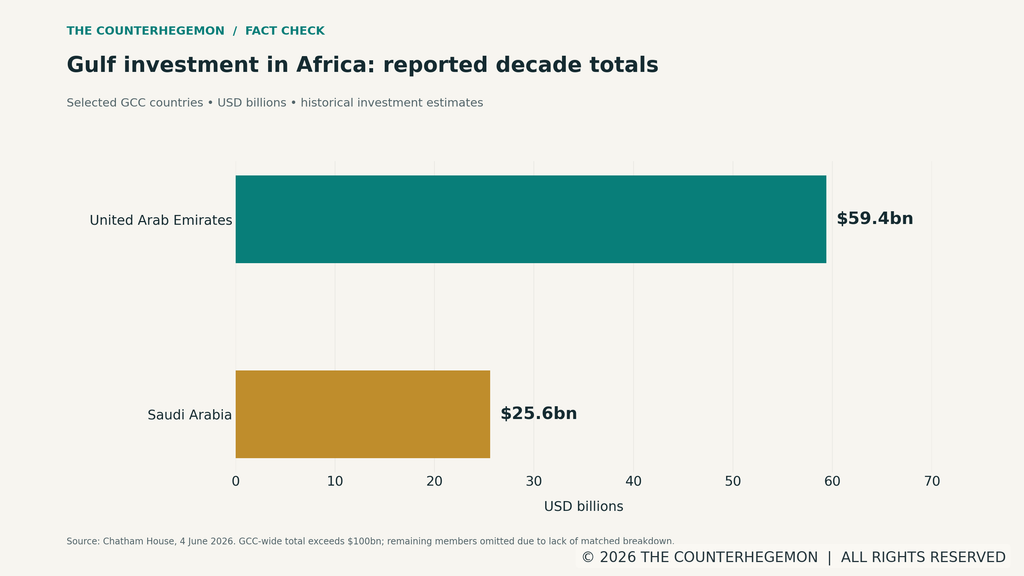
Reported investment by Gulf states in Africa over approximately a decade
Figures reported by Chatham House in June 2026. These represent historical aggregate investment estimates, not the value of assets currently owned.
Chatham House estimates that the Gulf Cooperation Council states collectively invested more than $100 billion in Africa over the preceding decade, led by the UAE and Saudi Arabia.
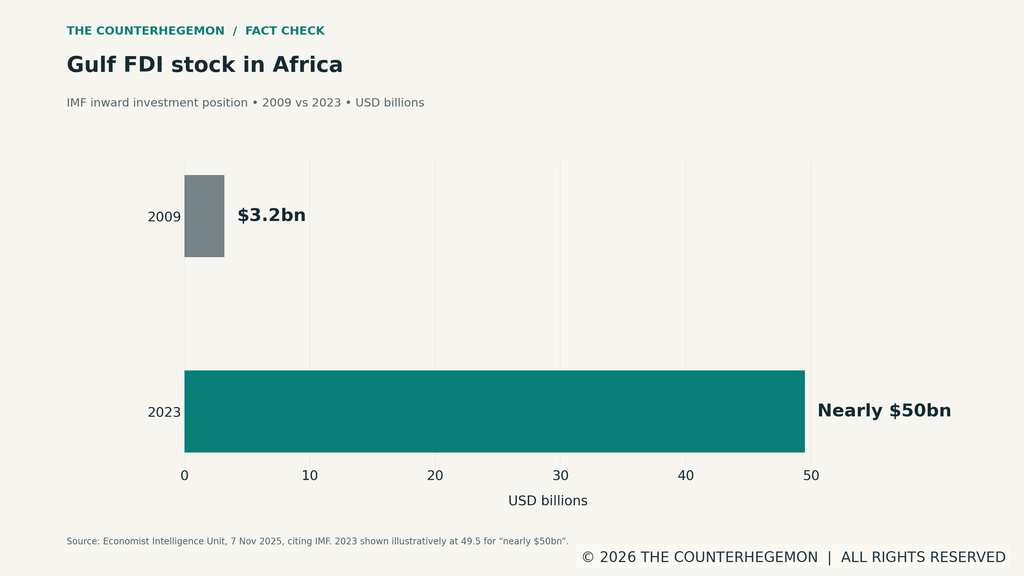
The Economist Intelligence Unit, using an IMF investment-position measure, reported that the stock of Gulf foreign direct investment in Africa had reached nearly $50 billion in 2023. These figures measure different things and should not be presented as contradictory totals.
No equally comprehensive and methodologically comparable public Israeli investment total was established during this review.
7A. Israeli economic partnerships with Muslim-majority countries
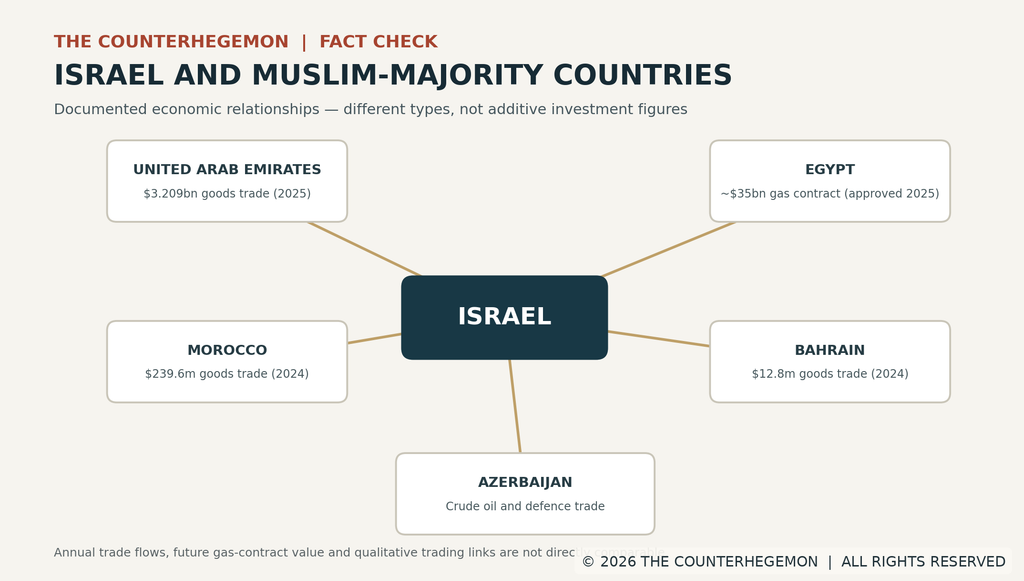
Religious identity does not divide these economies into separate commercial camps. Israel maintains documented economic ties with several Muslim-majority countries, even though their governments take different positions on the Palestinian question. These links do not imply that the partners act as one political bloc or that every agreement amounts to foreign direct investment.
United Arab Emirates — The UAE Ministry of Foreign Affairs reports $3.209 billion in bilateral merchandise trade with Israel in 2025. Its bilateral economic relationship grew following normalisation in 2020 and the subsequent trade agreement.
Egypt — Israel approved an agreement in December 2025 to supply approximately 130 billion cubic metres of natural gas from the Leviathan field to Egypt through 2040, under a contract valued at approximately $35 billion. This is the stated value of contracted future gas sales, not a completed investment or an amount already paid.
Morocco and Bahrain — UN Comtrade-based research records approximately $239.6 million and $12.8 million in bilateral merchandise trade with Israel respectively in 2024. These are annual trade flows, not the values of investments in Africa.
Azerbaijan — The Muslim-majority state is an established supplier of crude oil to Israel through the Baku–Tbilisi–Ceyhan route and has purchased Israeli defence equipment. The absence of a suitably comparable investment total prevents its inclusion in a combined monetary figure.
The relationships differ significantly: UAE merchandise trade, Egyptian gas purchases, Morocco’s and Bahrain’s annual goods trade, and Azerbaijani oil and defence links represent distinct forms of cooperation. None establishes the value of those countries’ shared investments inside Africa. Their relevance is political-economic: the same states whose African interests are presented in religious terms also participate in commercial relationships with Israel.
Source references: UAE Ministry of Foreign Affairs, Israel–UAE Economic Cooperation (2025 merchandise figures); Reuters, 17–18 December 2025, Israel–Egypt gas agreement; ORF Middle East/UN Comtrade, Israel–Abraham Accords trade 2021–2024; academic research on Israel’s oil-import policy (2025) and Israeli government publication on Azerbaijan–Israel relations (2025).
8. What the fact-check establishes
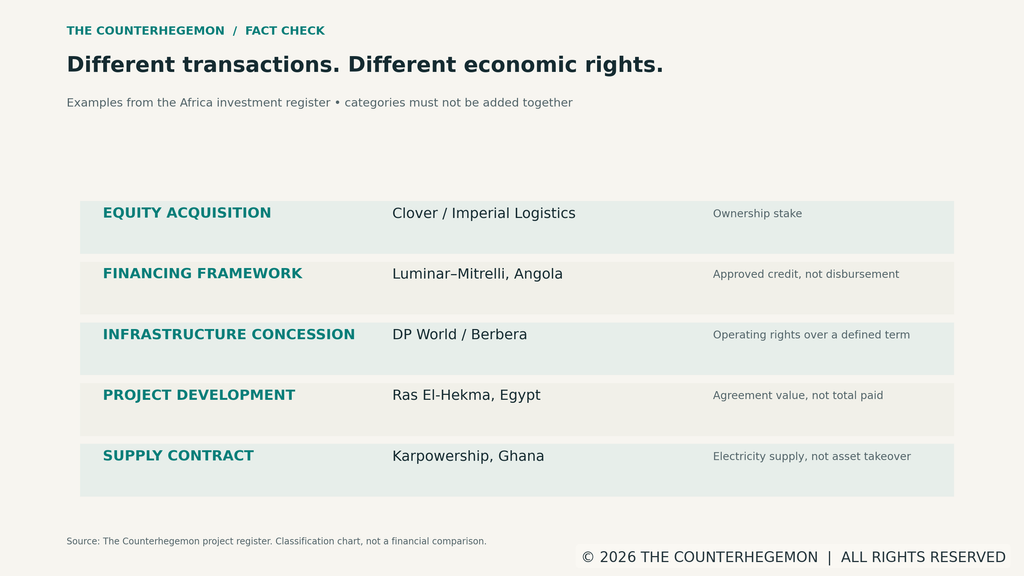
The expanded register identifies economic involvement in at least five major areas: food production and distribution; telecommunications; mining and mineral processing; ports and transport; and energy generation and infrastructure.
Several findings stand out.
First, commercial cooperation crosses the geopolitical divisions often presented as separating Israel from Muslim-majority countries. Israel and the UAE maintain diplomatic and trading relationships, demonstrating that religious identity and public political positions do not necessarily determine commercial alliances. Their strategic interests sometimes intersect, as seen in Somaliland, even as other governments oppose Israeli policies.
Second, the records show that foreign economic influence includes much more than buying companies. It also operates through minority equity, long-term concessions, government-backed financing, production-sharing agreements and infrastructure construction.
Third, Arab and Muslim-majority investors are not a unified bloc. Turkish interests in Somalia, Emirati interests in Somaliland, Saudi agricultural investments and Qatari energy investments reflect different national strategies.
Fourth, the investment figures require careful interpretation. A $2.7 billion loan framework, a $35 billion development agreement, a $500 million completed share purchase and a 30-year port concession cannot be combined into a meaningful total of assets acquired.
The evidence establishes extensive foreign economic involvement in African industries, natural resources and strategic infrastructure. It also reveals substantial differences between Israeli-linked commercial interests and those originating in Muslim-majority countries. These investors cannot be treated as two unified religious blocs, nor does the available evidence establish a coordinated programme of economic domination between them. The central issue remains African economic sovereignty: who owns and controls productive assets, who determines the terms of investment, who accumulates the profits and how much economic power remains in African hands.
Many private investments, subsidiaries and contract values are not fully disclosed. The entries above should be treated as a researched public register, rather than a definitive census of all foreign holdings.