

By Christiaan H. N. Carstens
Introduction
Pan-Africanist Marxist-Leninists in Azania (South Africa), as well as anti-imperialists and supporters of the emerging multipolar world more broadly, are delighted by the unveiling of the first road-bridge over the Tumen River – the Yakov Novichenko Bridge – the second trade corridor between the Russian Federation and the Democratic People’s Republic of Korea (DPRK).[i]
This delight takes place against the backdrop of a volatile geopolitical order enduring a fundamental period of transformation. During this era, the former US-headed unipolar global order representing imperialism is declining alongside its neoliberal-capitalist economic practices-and doctrines, as well as its liberal cultural hegemony which exalts individual want above collective need.
As this imperialist US-headed unipolar world order recedes in economic-, geographic-, political-, ideological, cultural-, and even military terms, the multipolar world order emerges and consolidates itself as a sovereign bloc. A geopolitical bloc consisting of nations united in the pursuit of their own sovereign development paths, mutually beneficial socio-economic cooperation, and political alignments outside of Western imperialist dictates.
Slowly but surely, the multipolar world is swallowing the former unipolar world order, with its largest representative – the US – even going so far as to admit that a multipolar world has arrived despite it clinging to imperialist ambitions. For example, in January 2025, US Secretary of State Marco Rubio, stated that it is “not normal for the world to simply have a unipolar power”. This statement signified a sharp break with the unipolar rhetoric of previous US administrations including the previous Trump administration. [ii]
The construction of the one-kilometre-long bridge was a joint Russian-DPRK venture which commenced in April 2025 and opened on Monday 7 September 2026. It is named after senior Soviet officer Yakov Novichenko, who saved the DPRK’s first head of state, comrade-leader Kim Il-sung, by jumping in front of a grenade.[iii] Thus, the naming of the bridge represents both the rejection of Western-headed imperialist aggression in the region, as well as the deepening of historical relations between two states seeking to pursue sovereign national development paths.
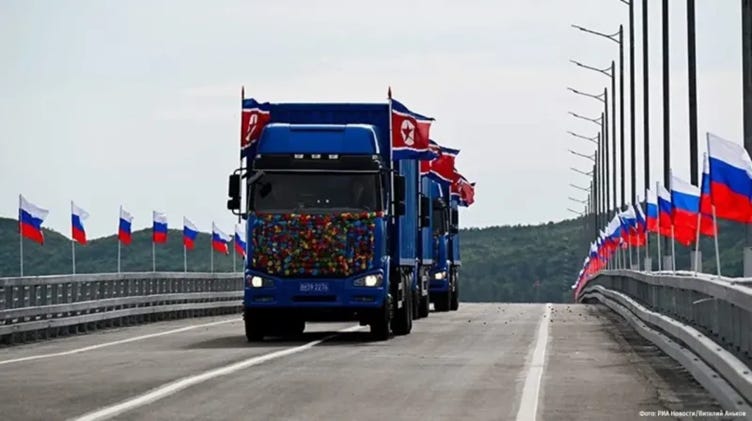
One of the first vehicles – namely a truck of the DPRK – transporting commodities crossing the Yakov Novichenko road-bridge across the Tumen River with dozens of Russian flags on each side of the bridge. Image provided by: nemoskva.net
1. Renewed Anti-imperialism and Support for Multipolarity
The new bridge was designed to handle a couple of hundreds of vehicles, as well as thousands of people, crossing it daily. Thus, the bridge brought into existence a strategically important physical link between Khasan region in the Russian far East, and the Northern Tumangang region in the DPRK.
The Western imperialist media complex has framed the building of the bridge as merely representing an attempt to evade the pernicious sanctions placed on Russia and the DPRK by the very imperialist powers this media complex seeks to legitimise. Imperialist mass media does not attribute the deepening Russia-DPRK ties to anything more substantive than a purely pragmatic geopolitical arrangement based on mutual military self-defence; such as a genuine vision for mutually beneficial cooperation between Eurasian anti-imperialist states.
There is a sinister reason for Western imperialist media to distort anti-imperialist cooperation and Eurasian integration on a multipolar basis. The distortion is meant to dissuade the various peoples of the world from pursuing sovereign national development paths. This is because the pursuit by nations of such a path would weaken Western global-monopoly capitalist hegemony, shrinking access to markets by imperialist powers, and thus lessening the profits of imperialist enterprises.
As Pan-Africanist Marxist-Leninists, we clearly recognise the bridge for what it is: a physical symbol of a broader Eurasian alliance forming between two staunchly anti-imperialist states – a predominantly Orthodox Christian civilisation-state[iv], as well as a deeply nationalist Marxist-socialist state[v].
The building of the bridge, within the context of the DPRK and Russia’s accelerating economic-and political links with China, is a sign of a deepening Eurasian triangular geopolitical alliance. This alliance finds itself in direct economic-, cultural, – and military opposition to Western-headed imperialism.
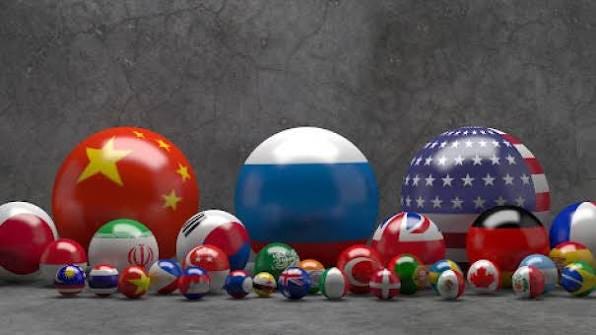
The image above represents state actors in the multipolar world. Image provided by: katehon.com
2. The Economic Dimensions: Anti-imperialist solidarity and Deepening Multipolarity
The economic dimension of the Tumen River bridge has particular significance for anti-imperialists who are also revolutionary socialists that recognise a multipolar world is the prerequisite for socialism spreading globally as a mode of production. This is due to the existence of the bridge providing a strong impetus for trade between the DPRK and Russia, but also China, through it functioning as an additional corridor linking the three countries. It also facilitates the potential for a great increase in bilateral cooperation between Russia and the DPRK that are constructing economies outside of the doctrinal paradigms of imperialism.
Mikhail Mishustin, Prime Minister of the Russian Federation, noted that the bridge functioning as cross-border transportation infrastructure significantly strengthens economic ties, but also cultural exchanges as well as technological cooperation.
He stated that he is “…convinced that the expansion of cross-border transport infrastructure will provide a powerful impetus for the further development of trade, economic, scientific, technological and cultural cooperation.”[vi]
For those of us who are Pan-Africanists, the bridge’s unveiling has special significance by illustrating that continental integration could be bolstered through the development of strategic infrastructure within the context of regional state integration, and that this is what leads to African sovereignty. It represents how physical infrastructure functions as the prerequisite for economic independence free from imperialism and its multinational corporations, as well as its financial institutions like the International Monetary Fund and World Bank.
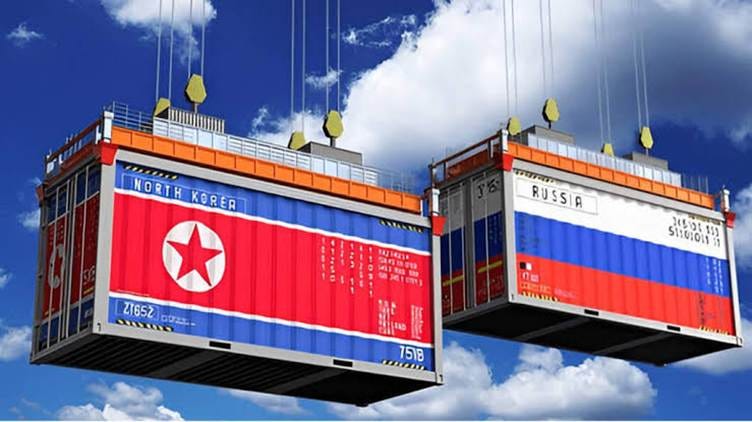
This image represents the increasing bilateral trade between the DPRK and the Russian Federation. Digital image of shipping containers provided by: russiaspivottoasia.com.
3. Geopolitical Shifts and Bolstering Anti-imperialism
Interpreting the building and unveiling of the bridge through a geopolitical lens of analysis, it becomes clear that the bridge has immense symbolic importance, which signifies a continued strategic dedication of the DPRK’s international relations doctrine.
Instead of Western propaganda fulfilling its goal of dissuading anti-imperialist states like the DPRK and the Russian Federation from pursuing their own sovereign development paths, imperialist sanctions have had the opposite effect. Eurasian integration on an anti-imperialist and pro-multipolar basis has significantly strengthened since the start of full-scale conflict in Ukraine in 2022 which led to the sanctions, especially given the DPRK’s material contribution to the conflict, as well as Russia’s aggressive geopolitical push for Eurasian continental integration.
The ongoing inter-state political consolidation of unity between Eurasian states poses an even larger threat to imperialism than before this accelerated process.
Eurasian continental integration on both an anti-imperialist and multipolar basis is highly threatening to imperialism’s global economic hegemony and profit-driven exploitation.
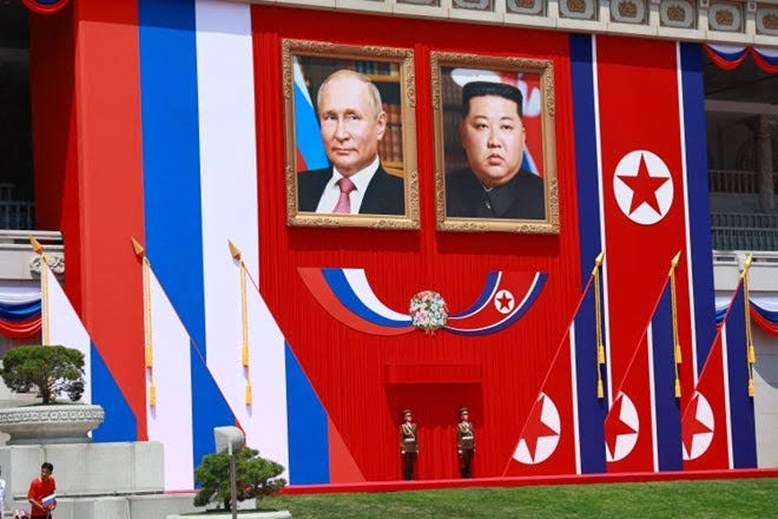
Two large portraits of Presidents Vladimir Putin and Kim Jong Un with the flags of the Russian Federation and DPRK surrounding it. These portraits were put on the headquarters of the central committee of the WPK in July 2023, and it signified the political unity and friendship between the Russian and Korean people. Image provided by: nytimes.com
4. Eurasian Military Cooperation and National Sovereignty
There is a crucial military dimension represented by the river-bridge connection between Russia and the DPRK, and these dimensions implication’s should not be ignored.
The bridge not only acts as a geographical link between like-minded anti-imperialist states, used for trade or civilian use. Instead, the bridge also acts as military infrastructure by providing logistical support for moving troops and weapons between the DPRK and Russia – two states directly confronting the geopolitical containment policies of imperialism.
Of course, the Western media has also identified this function of the bridge and labels such forms of military cooperation as signifying an inherent posture of military aggression towards the imperialist West – an ironic view coming from states that have for decades continuously opposed the DPRK and Russia through various means. Given the history of imperialist intervention in Eurasia – from the Western regions of Russia to the Asian far-East – it makes absolute sense that states seeking sovereignty and independent development would ensure that they are able to coordinate their militaries effectively in the case of renewed imperialist aggression. According to Mikhail Mishustin, the relationship between Russia and the DPRK is “at an unprecedented high level.”[vii]
For Azanians that remember our own national liberation struggle against colonialism and apartheid – especially revolutionary nationalist-and/or socialist former freedom fighters – are well aware of the concrete assistance provided by socialist states to our national liberation struggle efforts[viii]. Thus, the deepening cooperation between anti-imperialist Eurasian states is obvious to most Azanians as being a natural outgrowth of cooperation between states that assume a pro-sovereignty and working-class oriented political posture.
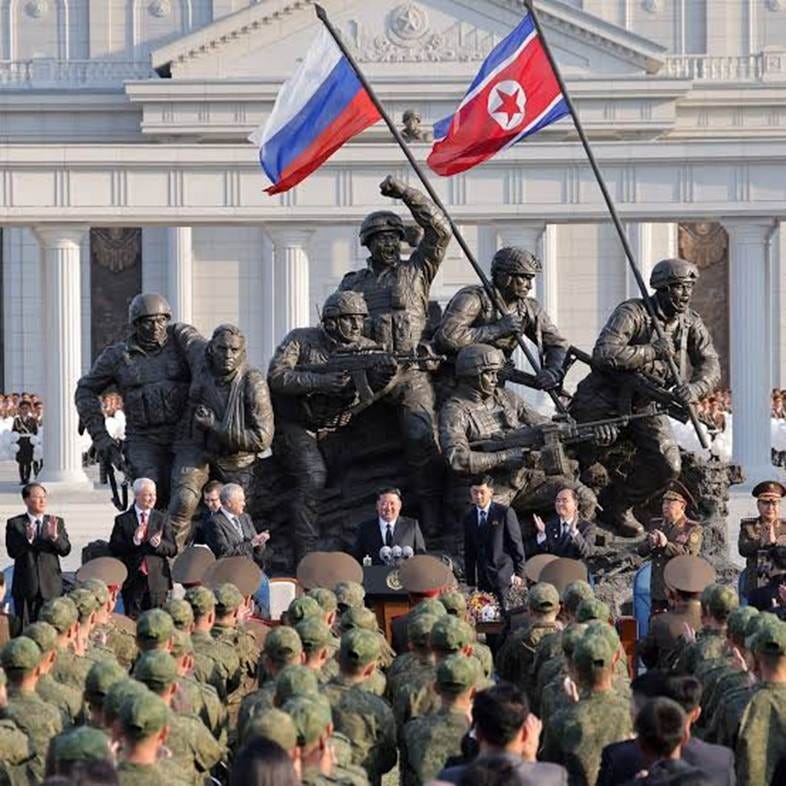
A memorial unveiled by the DPRK in 2026 glorifying the sacrifices of its soldiers who fell in combat fighting alongside Russian soldiers in Ukraine, representing a direct military engagement between these two states and the Western military forces of NATO and Ukraine. Image provided by: aljazeera.com
5. Lessons for Continental African Integration
For Pan-Africanists – those of us who advocate for a sovereign African civilisation-state, freed from the socio-economic legacies of colonialism – the DPRK-Russia road-bridge can be regarded as a development that offers valuable lessons for our own African historical mission of African civilisational rejuvenation and continental integration.
As Pan-Africanists actively working towards the integration of African states through supporting infrastructure projects that strategically evade falling into neocolonial patterns of trade, the Russia-DPRK bridge is regarded as a contemporary example of how infrastructure can accelerate and subsequently cement political alliances. The bridge demonstrates that concretely meaningful African continental integration fundamentally requires more than symbolic gestures or political rhetoric – more than political theatre and spoken or written words.
Instead, African continental integration requires the existence of infrastructure which facilitates the free movement of goods, peoples, military equipment, as well as Africanist and socialist ideas across the continent’s sovereign states committed to African anti-imperialist solidarity. This can only be achieved through revolutionary anti-imperialist and revolutionary socialist movements across the continent collectively working together. This political cooperation must be aimed at ensuring the destruction of the political-and economic power possessed by descendants of colonial-era capitalists who have maintained their capitalist economic dynasty, the comprador capitalist class[ix], neoliberal ideologues in academia and the media.
For Pan-Africanist Marxist-Leninists, the political lesson to be found in the unveiling of the bridge is that the construction of material infrastructural development programs as a component of our political strategy is a necessity. These development programs should then be connected to socialist struggle and the negation of the comprador bourgeois’ state power. The bridge is a powerful contemporary example that successful infrastructure developments outside of imperialist global structures-and dictates, is possible, and not a mere political dream.
However, this development must be guided by a powerful-, mass based-, and strategic African/Black nationalist and Marxist-Leninist ideology combined with a pertinent proletarian internationalist dimension, as well as revolutionary party leadership.

A stylised variant of the Black-, Green-, and Red tricoloured Pan-Africanist flag created by Marcus Garvey. Image provided by: redpepper.org.uk
Conclusion
As Azanians who are staunchly committed to constructing a society totally freed from colonial and apartheid socio-economic vestiges, we celebrate the building of the bridge between the DPRK and Russia as a victory for the construction of a multipolar world. We also recognise the need to break the economic-and ideological domination of imperialism that presents itself as universal, legitimising imperialism’s global domination in the eyes of large swaths of people around the world.
Without attacking imperialist global domination and its legitimising ideological framework, a multipolar world order, where civilisations and nations can be fully sovereign and pursue their own political, economic, and cultural development paths, will simply be untenable.
The Yakov Novichenko Bridge is both a material and metaphorical symbol. It is a symbol of integration within the Eurasian continent, as well as the connection between two anti-imperialist states that are revolutionary by virtue of their commitment to political projects aiming to build development models predicated on national sovereignty.
It has inspired Pan-Africanists and reminded us of the pressing need to decouple from imperialism and develop national economic autarky, as well as to break the power of the imperialist-aligned comprador capitalist class. This is to ensure that infrastructural projects linking states within the continent can commence, and that the projects primarily benefit the material needs of the mostly African and Black broad masses instead of domestic or foreign elite capitalist interests.
The development of the bridge should be viewed as representing anti-imperialist and multipolar cooperation which does not necessarily lead to Pan-Africanist Marxist-Leninist socialism, but that creates fundamentally positive political conditions for the pursuit thereof by revolutionary Pan-Africanist movements.

Image: An eight-pointed star, the symbol that often signifies support for the emerging multipolar world order across ideological lines. Image provided by: pngegg.com
[i] The first link between the DPRK and Russia is a rail-bridge that can be found in the same region in which the Yakov Novichenko Bridge can be found. It was built in 1959 and was officially called the “Korea-Russia Friendship Bridge”.
[ii] Rubio’s statement was made during an interview which was subsequently shared by the US Department of State.
[iii] In 1946, a grenade was thrownat Kim Il-sung as he delivered a speech commemorating the March 1 Independence Movement at Pyongyang Station Square. Soviet military guard Lieutenant Yakov Novichenko dove to intercept the grenade, which exploded in mid-air. Novichenko lost an arm and an eye, but Kim Il-sung survived unharmed.” – chosun.com.
[iv] A civilisation-state is a country whose identity, legitimacy, and political character is primarily a derivative of embodying an entire and continuous civilisation. This includes the civilisation’s long history; its culture and ethics; as well as traditions; rather than from the European nation-state model based on a single specific ethnic-, cultural-, and linguistic group, and territory.
A civilisation-state places emphasis on historical continuity and cultural unity across a geographically large and often ethnically, culturally, and politically diverse region. The term civilisation-state is often applied to describe the state-models of countries like as China, India, Russia, and Iran. When analysing Russian civilisation, it becomes clear that it fundamentally and predominantly, but not exclusively, assumes the form of Russian Christian Orthodox identity. Thus, the state of the Russian Federation, being a civilisation-state, regards Islam – its second largest national religion – as well as other established traditional religious groups, such as Roman Catholic Christians, as forming an integral part of Russian civilisation.
[v] The Socialist-Nationalist ideology, called “Juche”, is the official state ideology of the DPRK, promoted by the ruling Korean Workers’ Party (WPK) and it has been described as the adaptation of Marxism-Leninism to the Korean national context. The ideology emphasises Marxist analysis of historical development through class struggle, economic socialism, and vanguard-party leadership of the working-class specifically, and its allies more broadly. Juche also stresses Korean ethno-cultural nationalism, exalting Korean culture and rootedness in Korean ethnic identity.
[vi] Source: aljazeera.com
[vii] Source: bbc.com
[viii] The assistance provided by socialist states for the Azanian national liberation struggle came in the form of arms and munitions, military aid and training, as well as geopolitical support and ideological input. Numerous socialist states supported our national liberation struggle – including the USSR, China, the DPRK, and former East Germany.
[ix] The comprador capitalist class in African states, politically loyal to the neocolonialism of imperialism, represents a section of the capitalist class. This class plays an intermediary role between foreign imperialist capital and the national resources of the country. In effect, this class acts as the middleman that makes sure imperialist corporations can access the markets and resources of their countries.
The comprador capitalist class acquires its wealth and political power through enabling resource extraction and market access for foreign corporations instead of by engaging in productive national capitalist development. This class has a close relationship with foreign financial institutions, multinational corporations, and former Western colonial states.
The role of the comprador section of the national capitalist class in former colonial countries cements the economic dependency of former colonial nations on their former coloniser nations – the core characteristic of imperialism materially expressed in its neocolonial form.

Christiaan Carstens is a revolutionary Pan-Africanist, Marxist-Leninist, and Fanonist political activist of 7 years.