

By Gillian Schutte
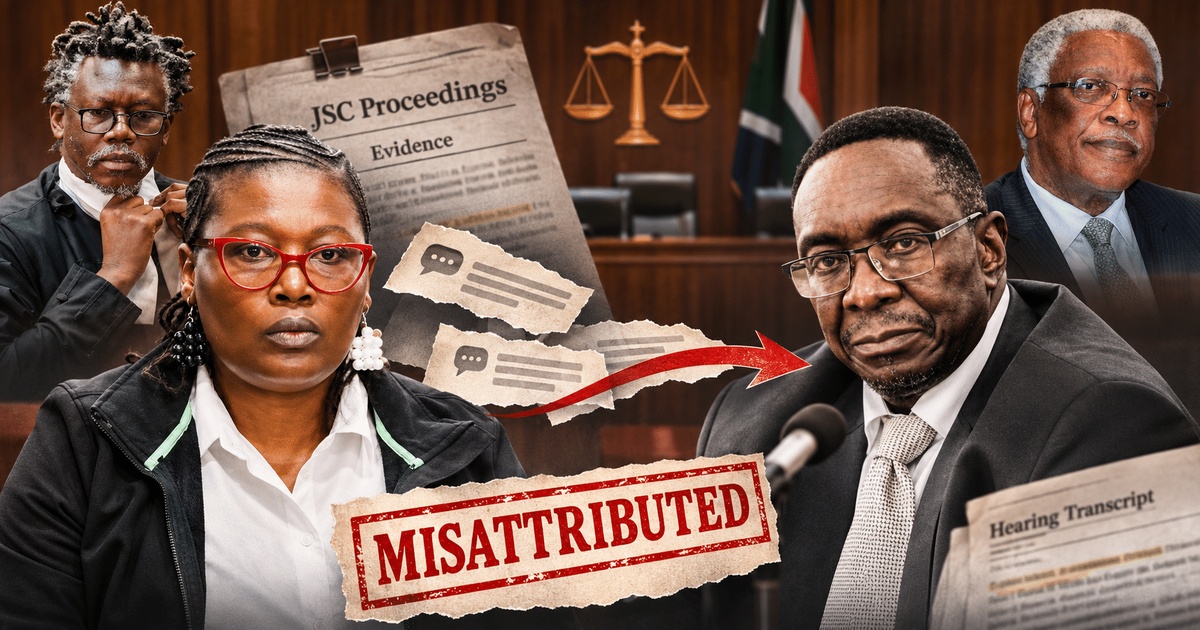
In his replying affidavit, Judge President Selby Mbenenge exposes a particularly disturbing feature of the JSC’s deliberations: Commissioner Tembeka Ngcukaitobi SC allegedly attributed some of the complainant’s own sexually suggestive remarks to Mbenenge, presenting them as evidence of the Judge President’s inappropriate conduct. Deputy Chief Justice Mlambo acknowledges incorrect attributions but maintains that “nothing turns on this”. What becomes of constitutional justice when the very institution entrusted with safeguarding judicial integrity treats the misattribution of incriminating evidence as inconsequential? Writes Gillian Schutte.
The Judicial Service Commission (JSC) appears increasingly willing to exercise the kind of institutional power against which the Constitution is supposed to protect South Africans. Its handling of the disciplinary proceedings against Eastern Cape Judge President Selby Mfanelo Mbenenge raises uncomfortable questions about judicial independence, procedural justice and the influence of organised civil society on the administration of law.
Mbenenge’s replying affidavit, filed on 23 November 2026, presents a disturbing account of how a constitutional institution arrived at a finding that could terminate his judicial career.
Seven times in the 81-page affidavit, Mbenenge uses the words “manifestly false”, repeatedly identifying statements that he contends are contradicted by the documentary record. These include assertions made by commissioners during their deliberations and allegations contained in the answering affidavit deposed to by Deputy Chief Justice Dunstan Mlambo on behalf of the JSC.
What emerges is an allegation that the Commission reached its conclusion and subsequently assembled the legal reasoning required to sustain it. If substantiated by the contemporaneous record, the implications for the credibility of the JSC are devastating.
The Judicial Conduct Tribunal heard witnesses, interrogated competing versions of events, assessed credibility and considered the hierarchy between Mbenenge and the complainant. It found that sexual harassment had not been established. It found him guilty of misconduct that fell short of the constitutional threshold for impeachment.
Significantly, Mbenenge points out that the Tribunal has not opposed his challenge to its finding of misconduct simpliciter. The review relief sought against the Tribunal remains uncontested by that body.
The central question in Part B of his application is whether the JSC lawfully, fairly and rationally converted a Tribunal finding of misconduct simpliciter into one of gross misconduct.
Its statutory entitlement to depart from the Tribunal’s conclusions does not confer upon it an unrestricted licence to reinterpret evidence, introduce adverse grounds without a fair hearing or manufacture retrospective justification for a predetermined outcome.
Who holds the JSC accountable when its own exercise of authority falls short of the standards it imposes upon the judiciary?
The NGO establishment and judicial power
South Africans should pay considerably more attention to the relationship between the judicial establishment and the network of non-governmental organisations that has acquired substantial influence over legal discourse, judicial appointments and disciplinary proceedings.
Through strategic litigation, public advocacy, media interventions and submissions to constitutional institutions, these organisations participate in determining the political and ideological climate within which judicial authority is exercised.
Freedom Under Law successfully litigated against the JSC over its handling of the complaint against Judge John Hlophe in 2011. It subsequently challenged the Commission’s rejection of the Tribunal’s gross-misconduct finding against Judge Nkola Motata.
In Mbenenge’s case, the Women’s Legal Centre represented the complainant and publicly challenged aspects of the Tribunal’s reasoning. Following the JSC’s decision, Judges Matter welcomed the escalation to gross misconduct and called upon Parliament to expedite the proceedings.
These are distinct interventions, but they illustrate the considerable institutional reach of organised civil society.
The problem arises when particular constituencies acquire the presumptive authority to define judicial integrity, determine what constitutes an acceptable disciplinary outcome and present their own ideological reading of events as the universal public interest.
The South African NGO sector is neither ideologically disinterested nor democratically representative of the population in its entirety. Its access to funding, litigation resources, mainstream media and influential legal networks affords it considerable power to shape public perception.
We should interrogate the class interests, institutional affiliations and ideological assumptions embedded in that power, particularly within a society whose legal establishment remains marked by colonial inheritance.
The JSC has an obligation to exercise independent constitutional judgement regardless of the preferences expressed by these organisations. Public advocacy, however influential, cannot become a substitute for evidentiary rigour.
The inconvenient precedent
The irony is that litigation initiated by Freedom Under Law provides Mbenenge with an important jurisprudential argument against the Commission.
In Freedom Under Law v Judicial Service Commission and Another [2023] ZASCA 103, concerning Judge Motata, the Supreme Court of Appeal found that the JSC had failed to justify its rejection of the Tribunal’s gross-misconduct finding.
That principle must operate in both directions.
If the Commission must provide legally sustainable justification for reducing gross misconduct to ordinary misconduct, it must meet the same standard when escalating ordinary misconduct into an impeachable offence.
The rule of law loses its integrity when jurisprudence is invoked selectively according to the desired outcome.
Those civil society organisations that celebrated the Motata judgement as a victory for judicial accountability should be equally concerned about whether the JSC satisfied its legal obligations towards Mbenenge.
Will they subject the Commission to the same scrutiny now that its decision corresponds with their publicly expressed preferences?
A conclusion in search of justification
Among the most disturbing allegations in Mbenenge’s replying affidavit is the account of how the JSC’s report was produced and subsequently adopted.
According to Mbenenge, an individual commissioner drafted the report after the decision had been taken and circulated it electronically. He disputes whether the requisite majority collectively considered and endorsed the substantive grounds contained in that document.
Section 178(6) of the Constitution requires majority support for decisions of the JSC. Section 20 of the Judicial Service Commission Act obliges it to furnish reasons for its findings.
The chronology is revealing. The Commission voted on 5 March 2026. The draft report circulated on 2 April. On 7 April, Commissioner Pillay SC wrote that reasoning was required for the part of the resolution declining to confirm the Tribunal’s finding that there was no sexual harassment.
Mbenenge further argues that only seven unqualified confirmations of the report are identifiable from the material upon which the Deputy Chief Justice relies. Fourteen commissioners participated in the March deliberations, meaning that eight constituted a majority.
Mlambo arrives at nine by including the qualified concurrence of Supreme Court of Appeal President Mahube Molemela and an email from Commissioner Pillay that Mbenenge disputes constitutes endorsement of the report.
Drafting a report after deliberations is perfectly permissible. Introducing substantive grounds that did not inform the original determination is another proposition altogether.
If the reasoning ultimately published by the JSC differs materially from what commissioners considered when they exercised their constitutional authority, whose judgement does the report represent?
The opinion of an individual commissioner cannot simply acquire collective constitutional authority through its subsequent circulation.
Nor should litigation provide the JSC with an opportunity to reconstruct the intellectual foundations of a decision already taken.
The Commission must defend the determination it actually made, on the grounds upon which it was made.
The denial of elementary justice
Mbenenge further alleges that the JSC relied upon written representations from the complainant that were never disclosed to him.
If established, this alone presents a formidable ground for judicial review.
The principle of audi alteram partem is foundational to our legal system. An individual facing adverse consequences must receive a meaningful opportunity to answer the material relied upon against him.
Yet here we have a Judge President alleging that the institution entrusted with maintaining judicial integrity incorporated arguments into its deliberations without extending to him the most elementary procedural protection.
The affidavit identifies what Mbenenge would have submitted had he been afforded that opportunity, including challenges to the Commission’s interpretation of his testimony, its characterisation of the Tribunal’s conclusions and its assessment of his remorse.
The prejudice is identifiable.
What extraordinary institutional arrogance would permit a body entrusted with safeguarding the administration of justice to dispense with the very principles that make justice possible?
The resurrection of an unproven allegation
The JSC’s treatment of the sexual harassment complaint exposes another difficulty.
Although it declined to endorse the Tribunal’s conclusion that sexual harassment had not been established, its operative finding concerned gross misconduct arising from a contravention of Article 5.1 of the Code of Judicial Conduct.
It did not clearly replace the Tribunal’s conclusion with an express finding of sexual harassment.
Yet the moral weight of that allegation continues to inform much of the public discourse surrounding Mbenenge.
A mutually flirtatious exchange conducted in an inappropriate professional context and sexual harassment are distinct legal propositions. The circumstances may warrant disciplinary action, but the classification of the conduct must follow from the evidence.
The existence of an institutional hierarchy is relevant to assessing consent, coercion and professional propriety. It does not relieve an adjudicating body of its responsibility to establish what occurred.
The Tribunal considered the disparity in professional status between the parties. The Commission’s dissatisfaction with the weight afforded to that evidence requires substantive explanation.
Here the repeated references to manifestly false statements in Mbenenge’s affidavit assume particular significance.
Commissioner Pillay SC is recorded as having described the Tribunal’s treatment of power imbalance as “a complete disregard of the issue of power imbalance”.
Commissioner Tembeka Ngcukaitobi SC is recorded as stating that the Tribunal did not mention power relations “at all”.
Mbenenge directs the court to paragraphs 34.2 and 38 to 44 of the Tribunal’s report, which explicitly address professional hierarchy, coercion, power imbalance and the expert testimony pertaining to these questions.
He contends that Mlambo’s answering affidavit seeks to soften the categorical nature of the commissioners’ statements by retrospectively attributing different meanings to their words.
Neither commissioner directly explains, qualifies or withdraws these assertions in their respective confirmatory affidavits.
How does the Deputy Chief Justice account for the stated reasoning of senior counsel when those commissioners themselves decline to provide a substantive explanation?
Equally alarming is Mbenenge’s allegation that Ngcukaitobi attributed some of the complainant’s own flirtatious messages to him during the deliberations.
According to paragraph 40 of the replying affidavit, Mlambo acknowledges the incorrect attribution of one or two statements but responds: “Nothing turns on this.”
How could nothing turn on the incorrect attribution of sexually suggestive messages in proceedings concerned with the conduct of the parties to those very exchanges?
A factual error of this nature requires substantive consideration, particularly when the institution concerned is deliberating on the possible removal of a judicial officer.
Gender justice itself is ill-served by a jurisprudence in which ideological conviction is allowed to determine factual conclusions.
The weaponisation of remorse
The Commission’s assertion that Mbenenge demonstrated no remorse warrants particular scrutiny.
In his replying affidavit, he identifies two written apologies, dated 24 March 2023 and 26 October 2023. The latter included an offer to make amends. Both were tendered prior to the presentation of evidence.
Yet the Deputy Chief Justice’s answering affidavit alleges that Mbenenge never apologised to the complainant for what he sent her.
In paragraph 101, Mbenenge characterises this assertion as manifestly false.
He maintains that the JSC afforded him no opportunity to address its adverse assessment of his contrition.
An apology may be considered inadequate or insincere, but such an assessment requires engagement with the evidence.
More disturbing is the possibility that his refusal to concede the allegation of sexual harassment was interpreted as an indication of his moral unfitness.
In paragraph 38 of the replying affidavit, Mbenenge draws attention to Commissioner Pillay’s contribution to the deliberations. Having read his answers to questions put by his own counsel, she stated:
“On my submission, that evidence is what changes his conduct from misconduct simpliciter to gross misconduct.”
Mbenenge identifies paragraphs 12.1.3 and 12.1.4 of the JSC report as adopting that submission.
Mlambo maintains that the Commission did not hold Mbenenge’s defence against him. Yet, according to the replying affidavit, the Deputy Chief Justice does not deal with Pillay’s actual words.
What kind of jurisprudence requires an accused person to surrender his defence in order to demonstrate that he is worthy of leniency?
The exercise of the right to defend oneself against an allegation cannot legitimately be treated, in itself, as evidence of culpability.
Such an approach introduces an authoritarian logic into disciplinary proceedings, in which the accused must accept the institution’s preferred version of events as a condition of rehabilitation.
The disciplining of Black judicial authority
The Mbenenge case must also be situated within the unfinished project of judicial transformation in South Africa.
Formal constitutional equality has not eradicated the historical distribution of authority within the legal profession. An African judge may occupy high office while remaining subject to institutional expectations shaped by an establishment that historically regarded Black intellectual and judicial authority as subordinate.
We must examine how disciplinary power operates within this historical context, whose professional transgressions attract sustained public campaigns and whose conduct is treated as an individual aberration.
The question of selective institutional severity cannot be dismissed simply because the Commission itself includes Black commissioners.
Hegemonic power does not require the racial identity of its original architects to reproduce itself. Its assumptions become institutionalised through professional hierarchies, inherited legal cultures and the internalisation of established standards of legitimacy.
An African judge should never be required to demonstrate a higher degree of moral perfection to retain an office constitutionally entrusted to him.
Nor should judicial transformation be reduced to demographic representation while leaving the deeper architecture of institutional authority intact.
Whether such selective treatment occurred in Mbenenge’s case requires comparative evidence. The broader question, however, remains indispensable to any critical understanding of South African judicial politics.
Where is the justification for impeachment?
The constitutional distinction between misconduct and gross misconduct exists for a reason.
Section 177 provides for the removal of a judicial officer in circumstances of exceptional gravity. It protects judicial tenure against arbitrary interference while providing mechanisms for addressing conduct incompatible with continued office.
The Tribunal found that Mbenenge had breached the standards of judicial office. Without abandoning his challenge to that finding, Mbenenge proposed a reprimand as an appropriate corrective measure in the alternative.
The Commission considered his conduct sufficiently grave to initiate the constitutional process towards removal. Its obligation was to explain adequately why the established transgression warranted that escalation.
Mbenenge argues that the Commission never substantively considered whether a reprimand or another remedial measure would suffice. Mlambo’s position that the question of a reprimand fell away once gross misconduct had been established is, according to Mbenenge, circular reasoning.
Whether a lesser disciplinary measure would suffice forms part of the inquiry into whether the conduct warrants removal from judicial office.
Has the JSC demonstrated why corrective disciplinary measures would be insufficient? Has it established why Mbenenge’s continued occupation of judicial office is untenable?
Moral condemnation alone cannot discharge that constitutional responsibility.
Impeachment must never become an instrument of exemplary punishment designed to satisfy influential constituencies or demonstrate an institution’s responsiveness to prevailing public sentiment.
The JSC must answer for itself
The Commission occupies a position of considerable constitutional authority. It determines judicial appointments, exercises disciplinary jurisdiction and influences the composition of an institution upon which the protection of our constitutional rights depends.
Its own conduct must consequently be subjected to uncompromising scrutiny.
The cumulative allegations contained in Mbenenge’s replying affidavit present a substantial challenge to the lawfulness of its decision.
The relief sought by Mbenenge, set out in paragraph 122 of his affidavit, is unequivocal. He asks the High Court to review and set aside the Tribunal’s finding of misconduct simpliciter, the JSC’s resolutions adopted by ballot on 5 March 2026 and its report and reasons of April 2026. He seeks a declaration that he is not guilty of misconduct.
In the alternative, should the court refuse to set aside the Tribunal’s lesser finding, he asks that the decision contained in paragraph 99 of its report, finding him not guilty of gross misconduct, be upheld. He seeks substitution of the Commission’s decision and the imposition of a reprimand or another appropriate remedial measure.
Should substitution be refused, he asks for reconsideration by a differently constituted panel or commissioners other than those who participated in the deliberations of 5 March 2026.
If the documentary record substantiates Mbenenge’s account, the High Court should set aside the gross-misconduct finding and its consequential decisions.
The JSC cannot arrogate to itself a moral and constitutional superiority that places its actions beyond the reach of judicial review.
Neither should South Africans outsource their critical faculties to an NGO establishment whose interpretation of the public interest has acquired disproportionate authority in our national legal discourse.
Mbenenge should win because constitutional institutions must remain answerable to the Constitution, including when accountability proves inconvenient to the constituencies accustomed to defining it.
Judicial independence is imperilled when the bodies charged with protecting it exercise their authority without rigorous adherence to due process.
The JSC stands accused of compromising the very principles upon which its constitutional legitimacy rests.
It must answer.
Mbenenge’s Replying Affidavit: How Ngcukaitobi allegedly attributed Mengo’s own words to Mbenenge