
By Gillian Schutte
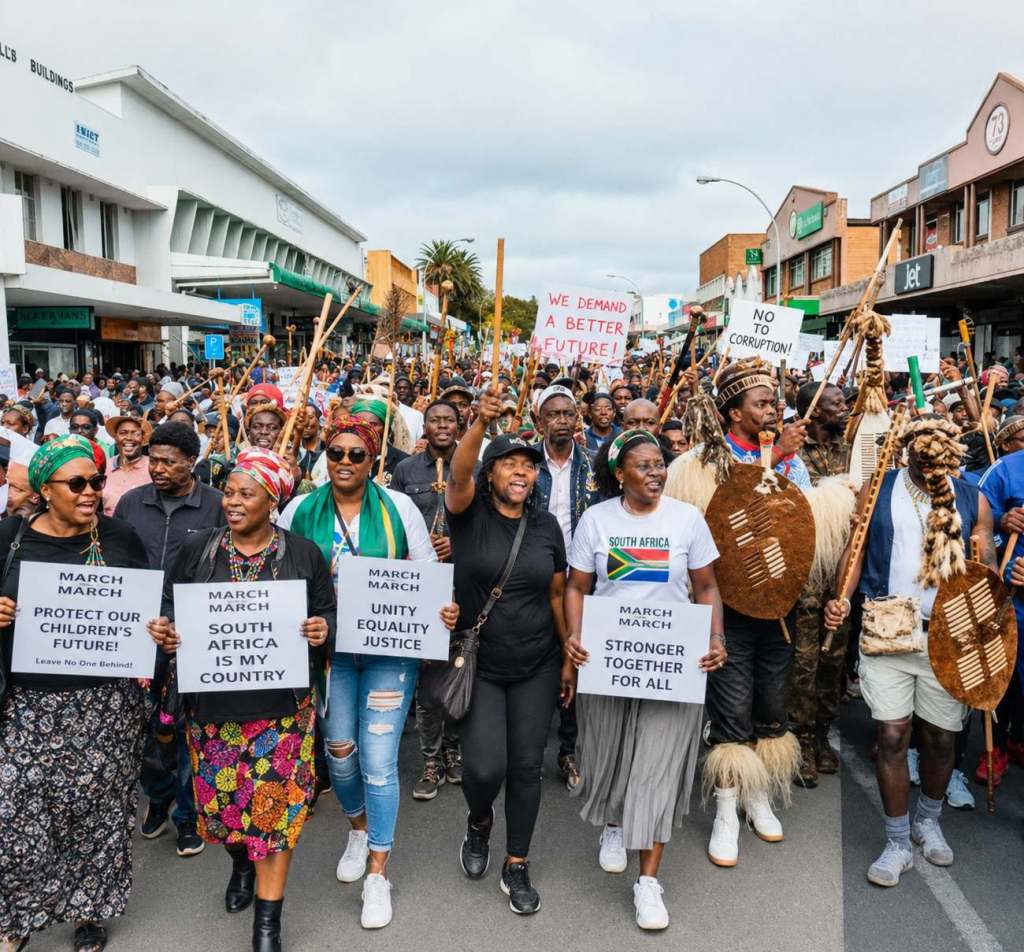
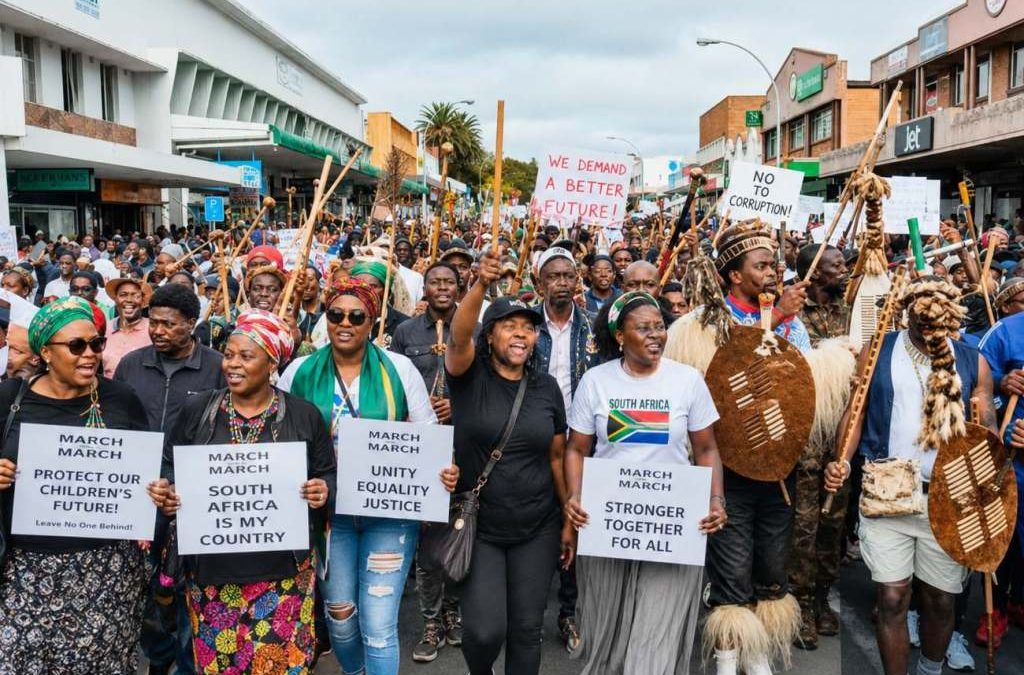
What unfolded around March and March was a chaotic, uncoordinated attack by people who imagine themselves as guardians of society. For clarity, I refer to the movement as MaM. Rumours crashed into one another before any coherent political reading appeared. Israel, an Israeli billionaire, Betway, Russia, Zuma, MK, ActionSA, paid influencers, the nuclear lobby and Christian conservatives all took turns as phantom authors of the march. Anything and anyone served the story, apparently, except the people themselves. Frankly, I am a little bit embarrassed for the gatekeepers.
The marchers were far more organised than the well-resourced media and NGO harpies trying to discredit them. MaM mobilised around a recognisable terrain of unemployment, border collapse, clinic queues, overcrowded schools, wage suppression, township economies, rental pressure, municipal decay and state abandonment. Its opponents produced suspicion, innuendo and moral panic.
I examine these rumours as political symptoms. I also psychoanalyse them as elite defences against an intolerable fact: dispossessed Black South Africans may have looked at their own lives and reached a political conclusion without donor scripting, party command or foreign purchase. That possibility unsettles a class comfortable with Black pain as testimony, research material and grant language, while political anger from below terrifies it.
Rumour as Political Method
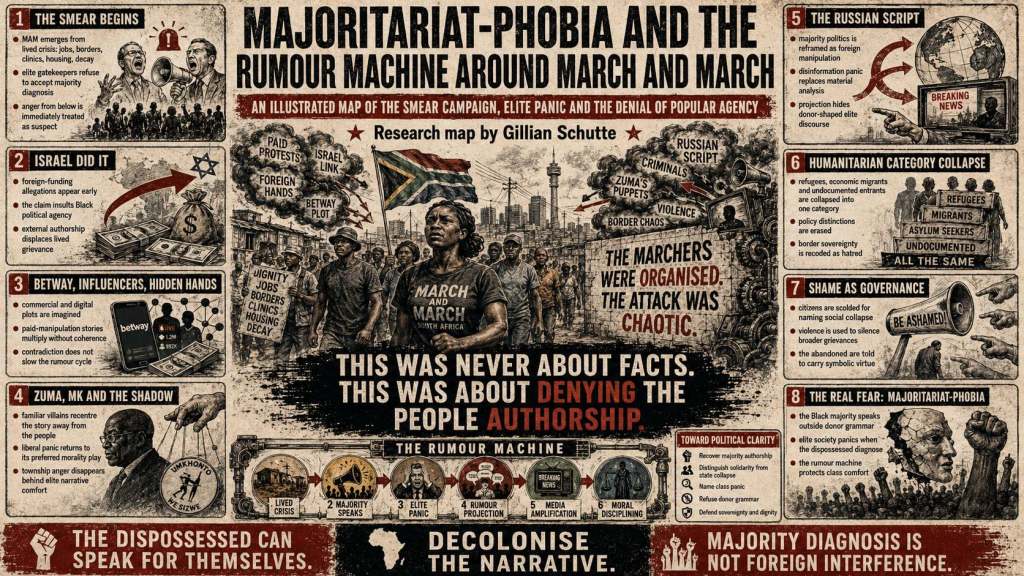
The funding rumour was about authorship: the power to decide who names crisis, interprets township anger and declares that the post-apartheid state has failed the people it promised to liberate.
The NGO-managerial class answered with remarkable speed. In its reading, the indigenous majority did not arrive at this position through lived experience. A handler had to be imagined behind the march because the alternative threatened the entire liberal order: the people had read their conditions correctly.
Jacinta Ngobese-Zuma publicly rejected the foreign-funding allegations, saying MaM received no money from Israel or any foreign donor, and that such claims insulted Black South Africans by implying they lacked the capacity to unite around a common cause without external purchase.
By then, the allegation had already done its work. It poisoned the terrain so that grievance became secondary. Elite discourse manages majority anger through suspicion rather than engagement. It criminalises, pathologises and foreign-authors the voice from below.
The rumour machine displaced elite anxiety onto the crowd. Unable to face the scale of abandonment beneath the march, respectable society invented handlers.
Zuma Did It
This rumour performed a specific psychological task. Once MaM was placed near the former president, MKP or the “shadow of 2021”, the elite imagination relaxed. The people no longer occupied the centre of the story. A familiar villain did.
That manoeuvre allowed liberal commentary to avoid township anger and return to its favourite morality play: Zuma as the origin of irrational politics.
AmaBhungane traced links between figures around MaM and Zuma-family networks, while also recording that no evidence showed Jacob Zuma himself had manipulated anti-immigrant sentiment. Such a qualification should have slowed the insinuation machine. Instead, implication travelled faster than evidence.
Investigation has its place. Funding must be examined, political networks interrogated, while movements should answer fair questions. Manufactured certainty, however, requires more than a shoddy face map with interlinking arrows.
The Zuma frame removes Black South Africans from the centre of their own revolt. It protects the liberal class from the possibility that the anger may be real, widespread and rooted in material life.
The Russians Were Behind It
The Russia framing performed a related function. Moscow has become the great explanatory object of liberal panic. Whenever majority politics exceeds the approved vocabulary of donor-funded civil society, the script appears: disinformation, malign influence, digital distortion, geopolitical contamination.
Such language flatters the liberal class because it casts them as defenders of democracy against a foreign psychological operation. It also helps them avoid the more pertinent question: why did so many Black South Africans find MaM politically legible?
The Russia rumour is rooted in imperial habit of thought. It assumes that political consciousness among the Black majority must have been imported once that awareness threatens elite wellbeing. Anti-Western sentiment gets recast as manipulation. Anger at donor-funded NGOs is labelled disinformation. Distrust of liberal media is treated as propaganda. Border politics gets framed as interference. Every refusal of liberal authority turns into proof of contamination.
That accusation reads as projection. The donor class knows very well how external funding shapes political language, research agendas, civil-society priorities, media ecosystems and acceptable moral frameworks. Yet it projects foreign authorship onto the majority. The same people accused of Russian capture live under narratives shaped by European and American donor power.
The charge therefore operates as confession in reverse. It accuses the majority of the dependency that saturates elite civil society.
The Humanitarian Obfuscation Around Migration
The next act was category collapse. War refugees, asylum seekers, documented residents, permanent-status holders, students, traders, cross-border workers, economic migrants, trafficked persons and undocumented entrants were pushed into one sacred humanitarian identity.
Once that altar is constructed, language loses meaning. Enforcing immigration law gets recast as Afrophobia. Border sovereignty is branded hatred. Concern about township economies is treated as violence. A South African asking why the state has abandoned its own citizens gets turned into an ammoral criminal.
A refugee fleeing war, persecution or direct political terror occupies a different legal and moral category from an economic migrant seeking work, trade, infrastructure, education, healthcare or opportunity. A person with lawful status stands apart from someone who entered through smuggling networks, overstayed, bought fraudulent papers or moved outside the formal immigration system.
These distinctions form the beginning of policy. Without them, the country receives emotional blackmail, NGO performance and unmanaged collapse.
Agency, Movement and Regional Inequality
Elite discourse also produced the myth of the migrant without agency. In this version, the undocumented economic migrant has no calculation, family network, cross-border strategy, return pattern, intention, knowledge of risk or capacity to make choices under pressure.
That view is infantilising. Vulnerability exists. Agency remains.
People move because they seek survival. They also move because they see an opening. South Africa, even in its broken state, still offers hospitals, roads, schools, grants, informal markets, urban infrastructure and work opportunities that neighbouring economies often fail to provide. Many migrants maintain households or land elsewhere. Goods and money travel home with them, followed by returns for Christmas, funerals, weddings, ceremonies, planting seasons and family duties.
That pattern describes economic migration under regional inequality. It differs from the condition of the war refugee facing death, imprisonment or total social collapse upon return.
Accuracy is a political necessity. Policy begins there.
Afrophobia, Violence and the Weaponisation of Shame
News reported that the June 30 protests organised by MaM took place across multiple cities, with looting in some areas, police intervention and arrests. The same report recorded the movement’s position that spontaneous acts of anger by South Africans did not fall under its responsibility.
The elite response used these incidents as a weapon against analysis. Once violence appears, the grievances beneath it get declared illegitimate. Border sovereignty is seen as mob rule. Enforcement is interpreted as hatred. Anxiety over township ownership is named xenophobia. The complaint of the abandoned citizen is cast as moral failure.
Shame then becomes a governing tool. Black South Africans are told that speaking about borders, jobs, spaza ownership, documentation and state failure amounts to hatred of fellow Africans. The abandoned citizen is instructed to carry the symbolic burden of Pan-African virtue while living inside municipal collapse, unemployment, overcrowded clinics and a state that has lost control of its own borders.
That claim is false.
A lawful country rejects violence against migrants through public order and prosecution. Refugee protection requires distinction instead of sentimental collapse. Dignity for foreign nationals belongs beside the refusal to make citizens disposable in their own land. African solidarity requires sovereign governance instead of administrative surrender.
The Spaza Economy and the Crumbs of Neoliberalism
The “migrants create jobs” argument carries the full arrogance of neoliberal thought. It tells Black South Africans to accept wage dependency where ownership should stand. It instructs them to accept crumbs from someone else’s table because those fragments technically count as employment.
That argument amounts to trickle-down economics in human-rights language.
The spaza economy reaches far beyond a marginal hustle. UCT’s Graduate School of Business cites estimates of around 150,000 spaza shops in South Africa, contributing about 5.2% to GDP and employing 2.6 million people, within a township economy estimated at around R900 billion. This is food access, storage, credit, transport, refrigeration, wholesale networks, distribution, security, rental space, neighbourhood circulation and everyday survival. Control over it reaches far beyond the sale of bread, airtime, mealie meal and cold drinks.
The question reaches beyond the individual migrant shopkeeper, many of whom are also trying to survive. The deeper issue lies in the structural exclusion of Black South Africans from ownership in the very spaces where they live. Young citizens are reduced to casual labour in an economy that should be theirs to build. Employment is offered as a substitute for ownership, procurement, distribution, supply chains and capital.
A people’s township economy would require state-backed finance, bulk-buying cooperatives, local distribution hubs, cold-chain infrastructure, protected municipal trading systems, safety regulation, youth training, supplier networks and serious capitalisation of Black South African ownership.
Elite imagination ends at the wage. It sees the Black majority as workers, beneficiaries and victims. Power shifts when ownership enters the frame.
The ICJ Trap and the Abuse of Palestine
Then came the most cynical moral weapon: the claim that South Africans who support Palestine at the ICJ have no right to demand immigration enforcement at home.
The comparison is obscene. Palestinians face occupation, bombardment, siege and violent displacement. Black South Africans live inside the unfinished violence of apartheid, neoliberalism, corruption, unemployment and state collapse.
Nobody consulted the abandoned citizens before turning the ICJ case into a whip against them. The pensioner in Soweto, unemployed graduate in Tembisa, shack dweller in Alexandra, clinic patient in Diepsloot, local trader in Umlazi, domestic worker in Khayelitsha, security guard in Mamelodi and mother sitting all day in a hospital corridor were never asked whether international solidarity requires them to accept collapsing services and lawless borders.
South Africans may stand with Palestine while resisting their own slow destruction by a failed state. Opposition to genocide abroad sits alongside a clear naming of social killing at home. Refugee protection and immigration enforcement belong in the same policy universe. Pan-Africanism does not require a border regime that abandons citizens to unmanaged survival wars.
Palestine must never become a gag on the South African dispossessed.
Majoritariat-Phobia
The elite media and NGO harpies have revealed their deepest fear: the Black majority speaking without permission. Black people are tolerated as case studies, beneficiaries, trauma extracts and grant language. They become threatening when they stop begging and begin diagnosing.
I have termed this fear: majoritariat-phobia.
Majoritariat-phobia names the panic that erupts when the majority refuses liberal management. It names the dread of people speaking outside donor grammar and naming the state, border, clinic, school, spaza economy, municipality and abandoned township in one political breath.
The rumour machine around MaM was therefore a defence mechanism. It protected elite society from the unbearable thought that the majority had reached its own conclusions. It allowed the NGO class to imagine manipulation where diagnosis stood. Media gatekeepers chased foreign ghosts instead of facing domestic failure.
The guardians of society have exposed themselves. Their compassion has limits. Their solidarity has class borders. Their human-rights language collapses the moment the Black majority speaks in a voice they do not own.
MaM forced that fear into the open. The accusations became frantic because the majority had escaped elite interpretation. The rumours revealed class panic. The well-resourced harpies were defending themselves from the dispossessed they claimed to understand.