
By Gillian Schutte
I had just written a deep critique of Julius Malema and the EFF as controlled opposition, advancing the rather inconvenient argument that South Africa’s most thespian revolutionary political party might actually be performing a valuable service for white monopoly capital, when a curious little WhatsApp landed on my phone.
It came from Melody Emmett, an independent writer, editor and journalist whom I would have imagined to inhabit that broad political universe of liberal commentators who have spent years warning South Africa about the terrifying revolutionary Malema. She had previously participated in a baseless campaign of defamation against me, apparently confident, back then, that I lacked the financial resources to take her to the cleaners.
The message read:
Dear Gillian,
I am not sure whether this is still your number. I have sent you an email.
I have been advised that you and your independent news and analysis platform The Counterhegemon, are funded by the MKP and/or Russian donors.
Would you kindly comment on this?
Please may I have your response by no later than COB on Friday 23 October 2026.
Kind regards,
Melody Emmett
Independent writer, editor, journalist
Well, well, well.
There I was, having finally turned my Marxist attention towards the revolutionary credentials of the man South Africa’s liberal establishment claims to fear most, when I suddenly found myself the subject of an alleged Russian and MK Party funding investigation.
Apparently, questioning whether Julius Malema serves as a political shock absorber for capitalism is now sufficiently dangerous to invite speculation about international espionage.
I had been expecting a rebuttal, perhaps an indignant EFF response or an angry lecture about my failure to appreciate the revolutionary significance of parliamentary opposition.
What I did nit expect was a polite invitation from a liberal to explain my supposed employment by Moscow.
How delightful.
But before I deepen my theory about this extraordinary political arrangement, let me make a few confessions about Russia.
I love Russia.
I love Russian history, Russian literature, Russian food, Russian revolutionary memory, Russian architecture and that magnificent Russian refusal to smile at inanities.
I particularly admire the latter.
In Russia, people generally do not feel obliged to expose their teeth every time a stranger walks into the room. They smile when something genuinely amuses them. Imagine introducing this revolutionary concept to South African liberal society. Entire dinner parties in Constantia would pass in dignified silence. The NGO sector might collapse from a catastrophic shortage of appreciative facial expressions.
I admire Vladimir Putin too. Openly. Unapologetically. Without requesting advance moral clearance from NATO, the Atlantic Council, the Daily Maverick editorial board or an earnest democracy consultant from Stellenbosch.
I regard him as a formidable geopolitical strategist who has refused to submit Russian sovereignty to Washington’s preferred international arrangements. I admire his intelligence, his composure and his understanding that a nation with Russia’s history has no obligation to organise its political existence around the emotional requirements of the Western liberal establishment.
Naturally, this makes me exceptionally dangerous in South Africa, where ideological independence is increasingly diagnosed as a symptom of foreign influence.
I have also recently returned from Russia, having visited St Petersburg and Moscow. I stood among the architectural treasures of St Petersburg, absorbed the memory of the Siege of Leningrad, walked through landscapes shaped by imperial history and revolutionary upheaval, and encountered a country whose historical consciousness has not been entirely surrendered to Western liberal interpretations of the twentieth century.
I ate healthy Russian food, admired Russian resilience and found myself surrounded by people who seemed remarkably uninterested in the moral instructions routinely dispatched from London and Washington.
I also failed spectacularly to meet my alleged Russian paymasters.
Nobody approached me in a dark Moscow corridor, slipped a brown envelope into my handbag and whispered, “Comrade Schutte, the Kremlin has decided that Julius Malema must be exposed as controlled opposition. Kindly return to South Africa and write something devastating.”
A terrible disappointment, financially speaking.
Given the costs of running an independent publication, I would have welcomed the opportunity to negotiate a decent editorial retainer. Perhaps even a little apartment overlooking the Neva, a Russian chauffeur named Sergei and unlimited pelmeni.
Instead, I returned home with memories, photographs, a renewed appreciation for Russian civilisation and, apparently, an unexpected promotion from independent Marxist writer to international geopolitical asset.
One would think that a major world power might provide its operatives with better resources. A newsroom, perhaps. A social media manager. Somebody to handle the tedious formatting of WordPress articles. At the very least, a decent publishing budget.
Instead, here I am, still writing most of the content for The Counterhegemon myself, producing books with my own hands and wondering whether my imaginary Kremlin salary has been deposited into somebody else’s account.
Comrade Putin, if you are reading this, there appears to have been an administrative oversight.
In truth, I have become somewhat of a human embodiment of Russia in post-apartheid South Africa. Sanctioned by the NGO complex. Misrepresented and smeared by sections of the mainstream media. Caricatured by white liberals who read one William Gumede book on democracy and now host panel discussions in Constantia with titles like From Struggle to Strategy to Dinner at the Vineyard Hotel.
Like Russia, I am apparently dangerous, by which they mean resistant to ideological management. Like Russia, I refuse to outsource my political thinking to Western institutions. Like Russia, I am cast as some kind of ideological monster for declining to perform the required rituals of submission while empire repackages itself in rainbow fonts.
Of course, Russia has nuclear weapons. I have a laptop, a small publishing operation and an increasingly impressive collection of hostile WhatsApps.
The geopolitical imbalance is considerable.
Back in South Africa, meanwhile, I remain surrounded by bourgeois mayhem disguised as democracy.
A country where the professional human-rights industry has become a respectable career sector, complete with foundation grants, international conferences, expensive hotel lunches and an apparently inexhaustible supply of people explaining to the African working class why actual economic liberation is administratively complicated.
I have spent years questioning Western donor influence and the curious innocence routinely attributed to Washington-linked funding. Apparently, dollars arriving through Western foundations represent civil society. Alleged Russian funding represents international subversion.
WHOOOOOO!
Alert NATO! Summon Brussels! Someone fetch the smelling salts from the democracy-development conference!
One would think I had been discovered enriching uranium in my kitchen.
I also support Russian nuclear sovereignty and South Africa’s right to develop its own nuclear energy capacity. Unequivocally. Which should provide the renewable-energy evangelists and their foreign-funded policy consultants with enough material for several emergency webinars.
Meanwhile, the South African left remains an astonishing exhibition of revolutionary taxidermy.
We have tight-arsed Trotskyites who hate Stalin more passionately than capitalist exploitation, academics whose revolutionary enthusiasm peaks at foundation-funded seminars, and professional radicals whose preferred uprising comes with donor reporting requirements, constitutional oversight and a tasteful buffet.
Bourgeois liberals will denounce apartheid’s economic inheritance with tremendous feeling, provided nobody proposes interfering with the ownership of anything.
And then there is Julius Malema.
For years, the liberal establishment has depicted him as the red-bereted apocalypse approaching Sandton. The man who will nationalise Hyde Park’s swimming pools, redistribute Stellenbosch wine cellars and send the owners of private capital stampeding towards the nearest Australian consulate.
Every inflammatory speech produces another outbreak of constitutional palpitations in the leafy suburbs. Every frightened editorial adds another revolutionary medal to Malema’s chest.
Meanwhile, the banks continue banking. The mines continue mining. The Johannesburg Stock Exchange opens every morning, apparently unaware that the socialist apocalypse has been approaching for more than a decade.
It is a remarkable achievement.
In 2016, the EFF helped install DA-led minority administrations in major metropolitan councils.
Apparently, the road to socialism passed through the offices of the Democratic Alliance.
Lenin would have required a particularly substantial volume of explanatory footnotes.
Then came the Inanda Club affair, when reports linked Malema to one of Johannesburg’s most exclusive private clubs.
He explained that his wife was the member and that he enjoyed the associated spousal benefits.
Spousal benefits!
I remain enormously fond of this contribution to revolutionary dialectics.
Lenin gave us What Is to Be Done? Malema gave us spousal benefits at the Inanda Club.
Perhaps the revolution really will arrive on horseback, following a pleasant lunch and a little networking among the bourgeoisie.
But beneath the comedy lies a serious political question.
What if the liberal establishment’s relentless denunciation of Malema is precisely what sustains his revolutionary credibility?
Consider the arrangement.
The liberals announce that Malema is coming to destroy capitalism.
Malema announces that he is indeed coming to destroy capitalism.
The liberals scream.
His supporters cheer.
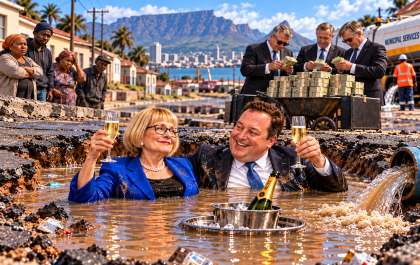
Capitalism orders another bottle of champagne.
It is a magnificent little theatre production in which everybody knows their lines and the working class keeps buying tickets to a revolution that never opens.
This is the political function I describe as controlled opposition. Popular anger is organised around revolutionary rhetoric but repeatedly returned to elections, parliamentary confrontations and constitutional negotiations.
The revolution is always approaching.
It simply keeps getting stuck in parliamentary traffic.
I once supported the EFF because I believed its revolutionary programme might confront the economic structures that survived apartheid. I took its promises seriously.
I no longer confuse revolutionary language with revolutionary organisation.
And herein lies the fundamental difference between my criticism and the liberal establishment’s.
They insist Malema is a dangerous revolutionary.
I question whether he is a revolutionary at all.
Their attacks provide him with credibility. Mine interrogates the political function of that credibility.
Their criticism makes him look like capitalism’s greatest enemy. Mine asks whether capitalism could have designed itself a more convenient one.
Which brings me back to Melody.
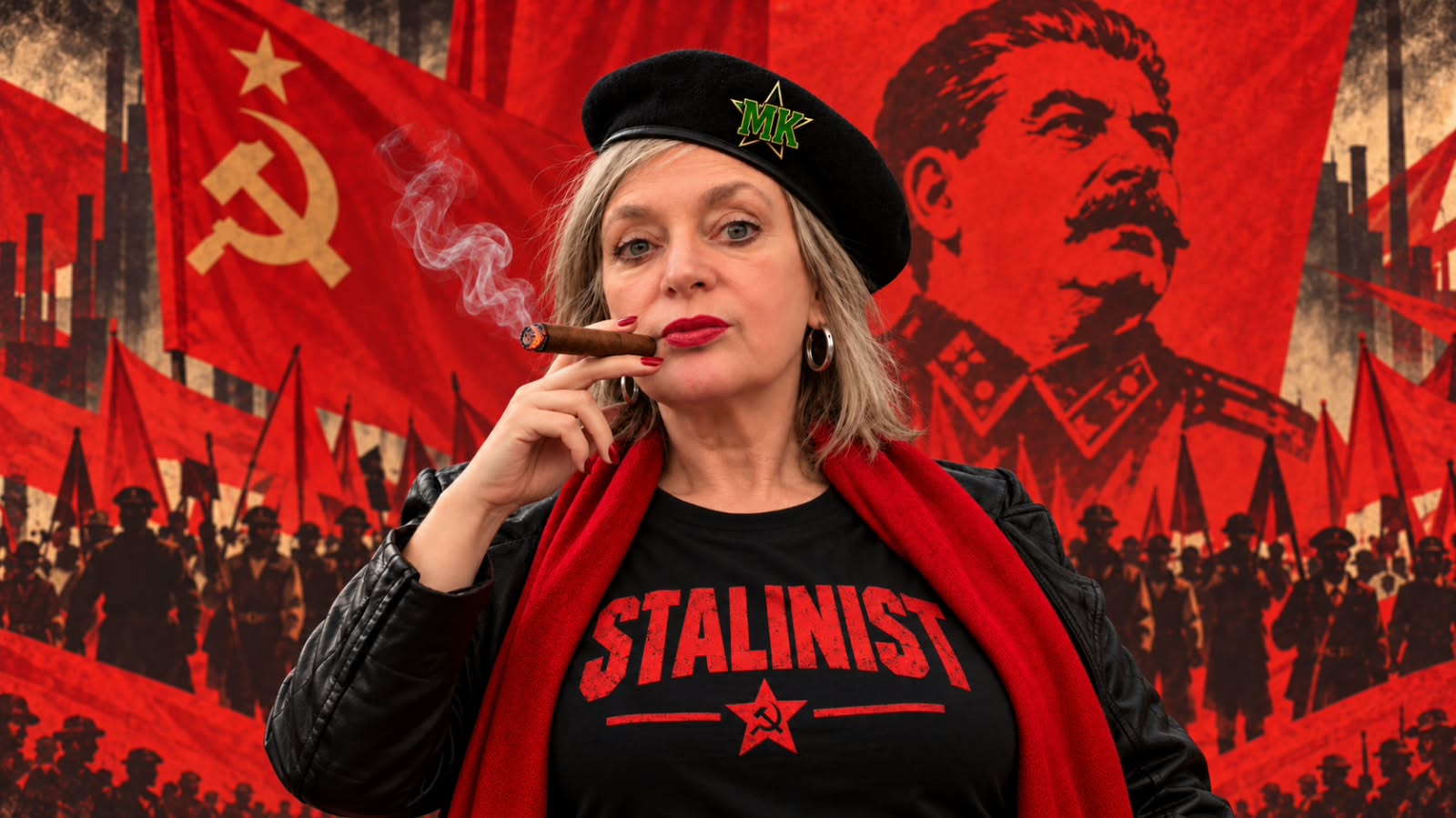
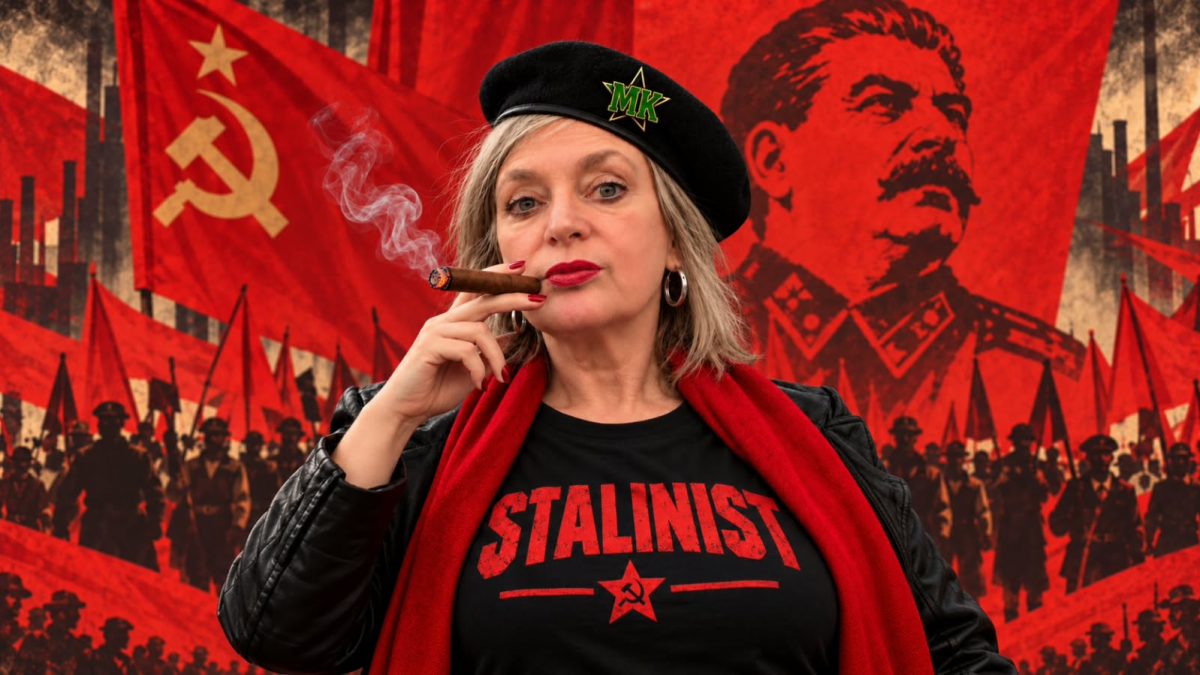
Having spent years being called a Stalinist, extremist and general menace to respectable society, I am accustomed to ideological excitement surrounding my existence.
Adam Habib once suggested I had not even been born when he was participating in the struggle. A remarkable historical achievement, considering I am a full year older than him.
Clearly, genuine left ideology possesses extraordinary anti-ageing properties.
But nothing quite prepared me for the spectacle of criticising Malema from the revolutionary left and receiving an enquiry about my alleged Russian and MK Party funding.
Of course, Melody’s message proves no connection to Malema or any coordinated operation. She says somebody advised her of an allegation. She identifies neither the source nor any supporting evidence.
Yet the timing presented an irresistible political irony.
Surely the professional anti-Malema industry should have welcomed my critique? Hadn’t these people spent years denouncing the red menace?
Apparently, calling Malema a revolutionary monster is one thing. Suggesting that the monster might be performing a useful service for capitalism is quite another.
Imagine spending ten years constructing a terrifying revolutionary monster, only to discover that somebody has started examining the factory.
The monster provides the spectacle. The liberals provide the panic. The media supplies the amplification.
And the bourgeoisie keeps the profits.
Instead of debating that arrangement, attention can conveniently turn to the person questioning it.
Who funds her? Who sent her? Is she an MK Party operative? Did Vladimir Putin personally order an investigation into Julius Malema’s revolutionary credentials?
One can practically imagine the Kremlin briefing.
“Comrades, NATO continues its expansion, Western sanctions remain in place, and the international balance of power is undergoing profound transformation. However, our intelligence services have identified an urgent strategic priority. A South African writer must publish an essay questioning whether the EFF functions as controlled opposition.”
The assembled Russian generals exchange grave expressions.
“Funding?”
“Unfortunately, none available. She will have to use her own laptop.”
A tragic failure of international communist solidarity.
And perhaps an even greater disappointment for my bank manager.
And that was when the penny dropped.
For years, these people have been telling us that Julius Malema is the most terrifying revolutionary since Lenin boarded the sealed train to Petrograd. They have practically built his revolutionary credentials for him, free of charge, with complimentary media coverage and a permanent supply of white liberal panic.
Yet the moment I suggested that their beloved monster might actually be helping to preserve capitalism, the alarm bells went off.
Suddenly, I was a Kremlin asset.
Melody’s enquiry gave the entire game away.
It was as though I had walked into a murder mystery, accused the wrong man of being the detective, and watched the entire cast leap up to defend the murderer.
Julius, I realised, was one of their own. Politically speaking, of course. I am describing his function within the capitalist order, not claiming membership of some secret bourgeois WhatsApp group.
The liberals get their terrifying communist. Malema gets his revolutionary credentials. Capital gets to keep the mines, banks and vineyards.
Everybody gets something, except the working class, which gets another election manifesto and a promise that the revolution is experiencing technical difficulties.
The genius of the arrangement is that the bourgeoisie has been doing Malema’s public relations for free.
And now, apparently, questioning the arrangement requires a security clearance from Moscow.
Melody, sweet Melody, I had been trying to explain my theory in several thousand words. You managed to illustrate its central irony in one WhatsApp. Remarkable editorial efficiency.
Naturally, your enquiry proves no secret coordination. But it has given me a splendid reason to pursue the political relationship between the revolutionaries who threaten capitalism and the liberals who keep announcing their arrival.
Meanwhile, I shall continue admiring Russia, eating pelmeni and refusing to smile at inanities.
The revolution will be televised, constitutionally approved, catered by the Inanda Club and postponed until further notice.
Do svidaniya, democracy.
And Comrade Putin, if you really are funding The Counterhegemon, please tell your accounts department to get in touch.
I have books to publish, a bourgeoisie to irritate and a revolutionary mystery to solve.
Apparently, all three are currently being financed by me.
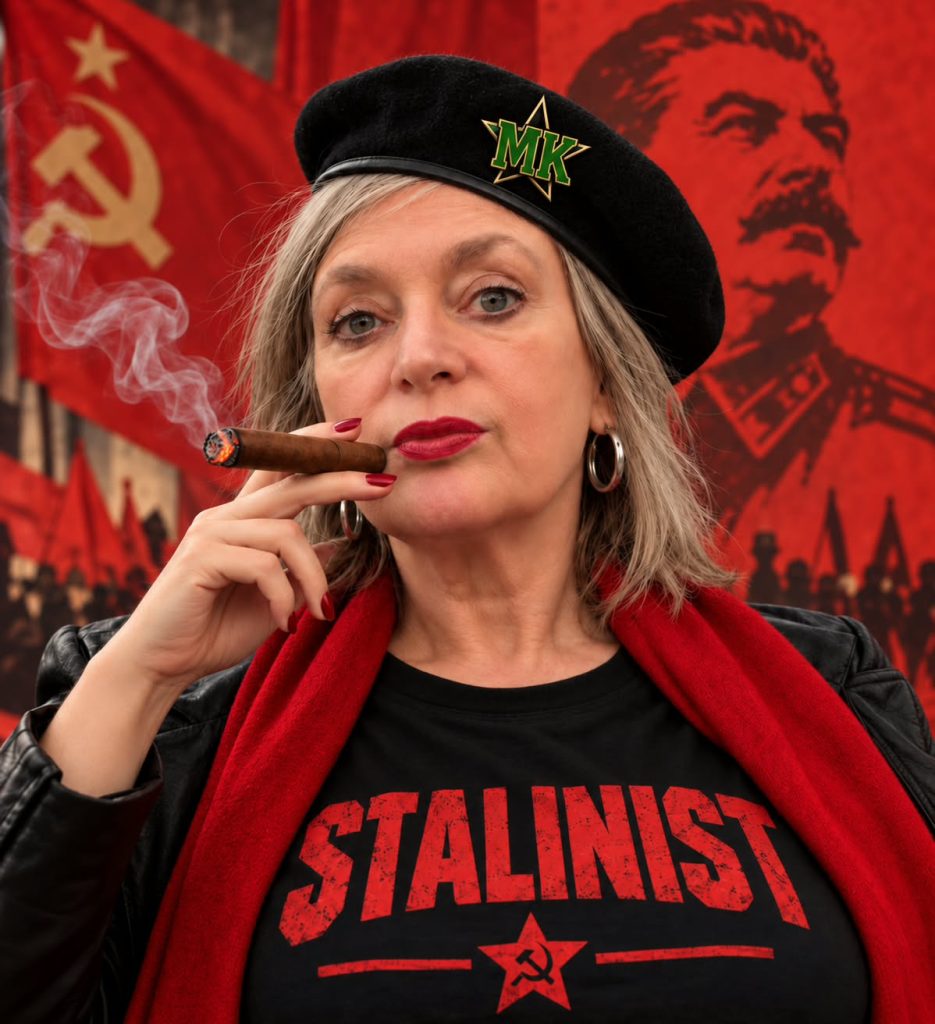
Gillian Schutte is a South African writer, filmmaker and editor-in-chief of The Counterhegemon. Her work examines African liberation, decoloniality, political economy, anti-imperialism and the ideological institutions through which power is reproduced.