
By Staffwriter
Claim: March and March has unleashed widespread and systematic lethal violence against foreign nationals.
Finding: The allegation is highly exaggerated, inconsistently evidenced and amplified through a selective politics of outrage.
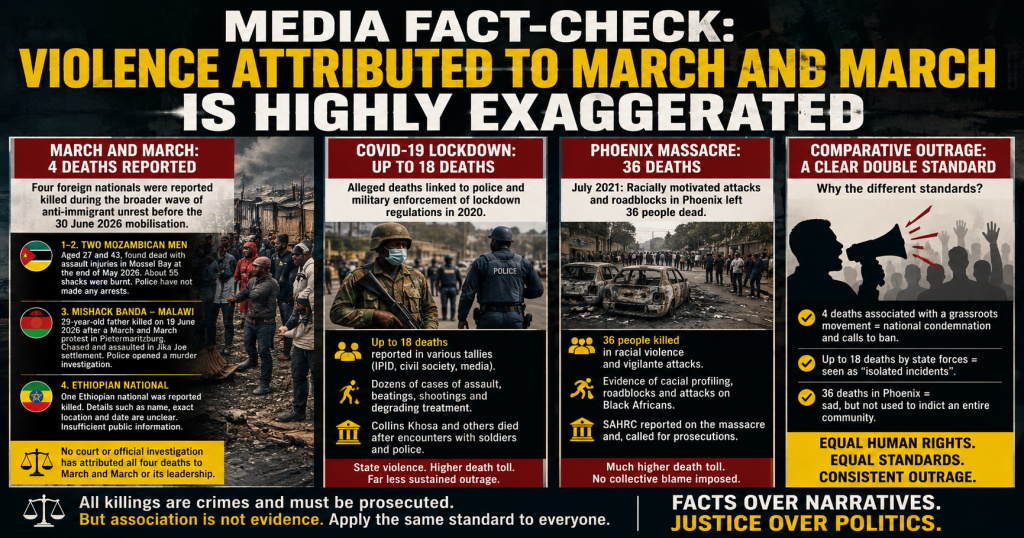
The “four deaths” repeatedly cited in international reporting refer to four foreign nationals killed amid the broader anti-immigrant unrest preceding and surrounding the 30 June 2026 mobilisation. They were not four people killed during the nationwide March and March demonstrations themselves. International reporting has frequently grouped separate incidents beneath the movement’s name without establishing that March and March members committed each killing, or that its leadership ordered or organised violence.
The four reported deaths
Two Mozambican nationals, aged 27 and 43, were found dead with assault injuries following unrest in an informal settlement in Mossel Bay at the end of May 2026. Around 55 shacks were reportedly burnt. Mozambique initially announced that five of its nationals had died, but South African police confirmed only two deaths caused by assault. Two other Mozambicans died in a road accident while returning home and cannot reasonably be counted as killings caused by the protests.
The Mossel Bay unrest was subsequently incorporated into a wider narrative of demonstrations allegedly “led or inspired” by March and March. Political influence, temporal association and geographical proximity, however, do not establish that the movement’s members committed the murders.
The third death was that of Mishack Banda, a 29-year-old Malawian father killed on 19 June 2026 after a March and March gathering in Pietermaritzburg. Reports state that a woman addressed the crowd and alleged that her brother had been killed by Malawians. Members of the crowd then entered the nearby Jika Joe settlement, where Banda was chased and fatally assaulted. His brother was also injured. This killing has the clearest temporal and physical connection to an identifiable March and March gathering.
Even here, reporting has not established that the organisation’s leadership instructed anyone to attack Banda. Criminal responsibility must be established against the individual perpetrators through investigation and prosecution.
The fourth reported victim was described as an Ethiopian national. Yet published accounts have not consistently supplied the person’s name, the exact location and date of death, a detailed police statement or a judicially tested account of what occurred. There is therefore insufficient publicly verified information to attribute this death directly to March and March.
The accurate formulation is that four foreign nationals were reported killed during a broader period of anti-immigrant unrest, while only one of those killings has a clearly reported connection to a March and March gathering. No court finding or publicly established police investigation has attributed all four deaths to the organisation.
Covid-lockdown killings: up to 18 deaths reported
The evidentiary restraint demanded in cases involving the police and military during the 2020 Covid-19 lockdown was markedly different.
During the first weeks of lockdown, IPID investigated multiple deaths associated with police enforcement. By 5 April 2020, eight deaths had already been reported to the police watchdog. By early May, IPID had published details of ten alleged killings linked to lockdown policing. Other contemporary civil-society and media tallies later placed the wider number of deaths associated with police and military enforcement at up to 18. The totals varied according to the reporting date, whether deaths in custody were included and whether cases involving the SANDF were counted alongside SAPS cases.
These were not deaths loosely associated with a political atmosphere. They arose during the direct enforcement of government regulations by armed state institutions.
Among the victims was Collins Khosa, who died after soldiers and police confronted him at his Alexandra home. His death led to litigation and a High Court order requiring the state to address abusive conduct by security forces. Human-rights organisations documented allegations of beatings, shootings, humiliation and excessive force directed overwhelmingly at Black working-class communities.
Yet civil society and the media did not sustain a narrative that the entire SANDF, SAPS or government had become an organised killing movement. Responsibility was more commonly discussed through the language of individual misconduct, inadequate training, failed command or excessive enforcement.
Phoenix: 36 deaths
The contrast is starker when March and March is compared with the Phoenix massacre of July 2021, where 36 people died.
The South African Human Rights Commission heard testimony concerning racial profiling, roadblocks, assaults and killings of Black Africans during the unrest. The Commission’s hearings examined allegations that African people were attacked after being racially identified and accused of involvement in looting. The event became known as the Phoenix massacre.
Thirty-six deaths constituted a death toll nine times higher than the four deaths now routinely placed beneath the March and March banner. Yet Phoenix did not generate a comparable, sustained civil-society campaign portraying every Indian organisation, community institution or political formation as collectively responsible for the massacre.
Correctly, criminal responsibility was expected to be established against identifiable perpetrators. The same evidentiary standard should apply to March and March.
Comparative outrage
The disparity is clear:
- March and March: Four deaths repeatedly associated with the movement, although only one has a clearly reported connection to one of its gatherings and no finding attributes all four to the organisation.
- Covid enforcement: Up to 18 alleged deaths associated with police and military enforcement, supported by multiple complaints and IPID investigations.
- Phoenix: Thirty-six deaths amid documented racial profiling and vigilante violence.
The issue is not whether the lives of migrants should be protected. Every assault and killing requires investigation, and perpetrators should be prosecuted. The issue is the radically uneven standard through which violence is narrated.
When Black South Africans were killed by soldiers, police or racially organised vigilantes, civil society largely demanded that liability be established case by case. When deaths occur during a period associated with March and March, political proximity is repeatedly converted into organisational culpability.
The outrage is therefore neither proportionate nor consistent. It reflects a media and civil-society hierarchy in which violence against dispossessed Black South Africans is individualised, bureaucratised or quickly forgotten, while violence involving foreign nationals is rapidly generalised into an indictment of a grassroots Black movement.
Verdict: Claims that March and March has conducted widespread or systematic lethal violence are unsupported by the available evidence. The four deaths cited in reporting are not equivalent to four proven killings by the movement. The scale of condemnation directed at March and March stands in sharp contrast to the muted and short-lived response to as many as 18 deaths during Covid enforcement and the 36 deaths of the Phoenix massacre.