

By Tirelo Al-Gore Seoke
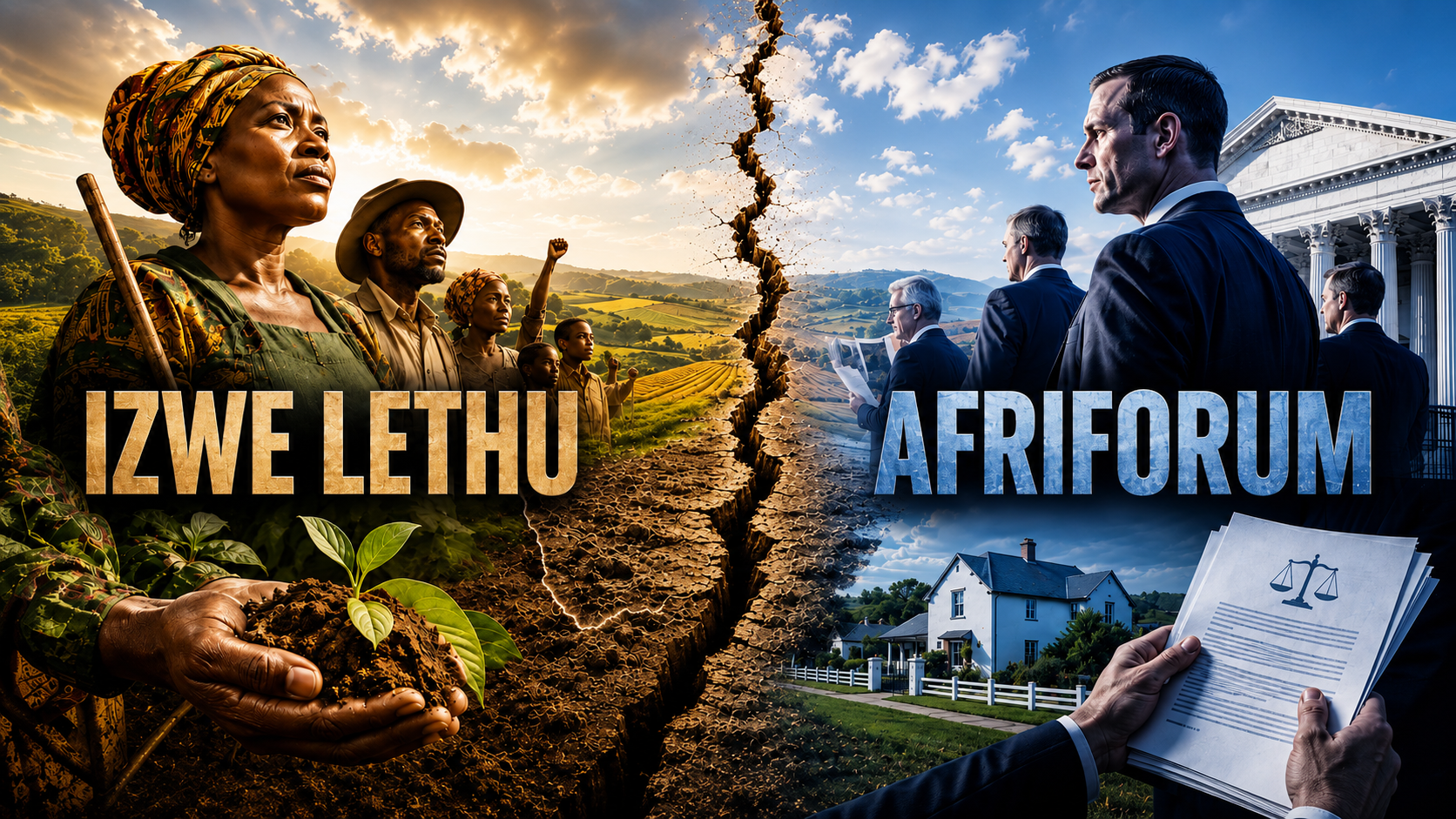
This month, the Western Cape High Court is hearing challenges to the Expropriation Act 13 of 2024 brought by AfriForum, the Democratic Alliance, the Institute of Race Relations and other applicants. AfriForum argues that provisions allowing nil compensation undermine Section 25 of the Constitution by creating statutory circumstances in which property may be expropriated without compensation. The Presidency disputes this interpretation, arguing that the Act retains the constitutional requirement that compensation must be “just and equitable”, with nil compensation possible only where the circumstances justify it.
At first glance, the dispute appears to concern the interpretation of property rights and compensation. Beneath this legal contest lies a much older question: who holds legitimate title to South Africa’s land, and from where does that title derive?
Land remains the most concrete symbol of colonial conquest and apartheid dispossession. The post-1994 land reform project has failed to deliver meaningful restoration because it operates within a constitutional order that protects property relations produced through conquest. The current court challenge therefore brings South Africa back to a question that the constitutional settlement never resolved: sovereignty.
Sovereignty is commonly understood as supreme authority over territory and freedom from external control. This definition obscures the genealogy of Western sovereignty. Western sovereignty developed through conquest, domination and the conversion of military victory into lawful title. Ndumiso Dladla and Anjuli Webster show that its defining characteristics include supremacy, permanence, absoluteness and territorial command. These ideas remain connected to the conqueror’s claim to rule over land and people.
The 1996 Constitution did not overturn all the legal consequences of colonial conquest. It constitutionalised a compromise between transformation and the protection of existing property rights. Section 25 contains this contradiction. Section 25(5) requires the state to take reasonable legislative and other measures to enable equitable access to land, while Section 25(1) protects existing property rights against arbitrary deprivation.
This split drives the land reform impasse. The dispossessed received the promise of reform. Those holding property at the time of the constitutional negotiations received protection for existing title, despite a history shaped by conquest, forced removals and apartheid dispossession. Sanele Sibanda and Ngwako Raboshakga explain that constitutional negotiators accepted existing property rights as legitimate while adopting limited redistributive commitments. The National Party’s constituency emerged with property protected. The ANC’s constituency received a deferred promise of redress.
The present litigation makes that contradiction visible. AfriForum told the Western Cape High Court that it accepts land reform as a constitutional imperative, while arguing that Parliament cannot identify categories in ordinary legislation where nil compensation may apply. Its position places the constitutional method of expropriation at the centre of the case. The state responds that Section 25 already permits a just and equitable assessment capable, in exceptional circumstances, of producing nil compensation.
Yet from a post-conquest jurisprudential perspective, both positions remain situated inside a constitutional framework that begins with the validity of existing title. The deeper question concerns the historical source of that title.
The right of conquest has a long history in Western political thought. Jean Bodin linked sovereignty to war and demonstrated how conquest could become a lawful basis for authority. John Locke criticised unjust conquest while developing theories that facilitated colonial dispossession through the classification of land as “waste”. Jean-Jacques Rousseau rejected the proposition that force creates right, yet Western legal systems repeatedly developed mechanisms through which force became recognised authority.
Kenneth Nunn’s description of law as a Eurocentric enterprise helps explain this transformation. Western law presented itself as neutral and universal while carrying a cultural worldview organised around hierarchy, abstraction and domination. Through legal doctrine, violence could be converted into title, conquest into sovereignty and dispossession into property.
Azanian philosophical thought challenges this foundation. Mogobe Ramose’s formulation, “I conquer, therefore I am the sovereign”, exposes the violence beneath modern sovereignty in South Africa. Conquest did not disappear when military conflict ended. It structured land ownership, political authority and legal title. Dladla extends this analysis by arguing that Blackness itself emerged as a political identity through conquest, fear and enforced obedience.
From this perspective, the post-1994 transition did not complete decolonisation. It managed the inheritance of conquest through constitutional compromise. The new order incorporated the conquered into a legal structure while leaving the original question of sovereign title unresolved.
This explains the failure of the willing-seller, willing-buyer model. That approach transformed the recovery of dispossessed land into a market transaction. The people from whom land had been taken without compensation were expected, through the state, to purchase it back. The model recognised existing owners as lawful title holders entitled to payment while placing the historical origin of ownership outside the transaction.
The debate over expropriation without compensation emerged from this contradiction. Heinz Klug argues that Section 25 already contains sufficient flexibility because compensation must be just and equitable and must take account of the history of acquisition, current use, market value, state investment and the purpose of expropriation. Lungisile Ntsebeza, however, identifies the political limits of this framework. Formal legal possibilities have existed alongside a market-led land reform programme that has delivered painfully slow transformation.
The Expropriation Act must be located within this history. It does not establish an unrestricted programme of land seizure. Section 12(3) identifies circumstances in which nil compensation may be just and equitable. This is the provision AfriForum has placed under direct constitutional attack. Its counsel argues that Parliament has effectively introduced through ordinary legislation something that the Constitution itself does not establish. The Presidency argues that the section supplies guidance within the existing constitutional standard and leaves courts as the final arbiters of compensation disputes.
The importance of the case extends beyond the technical interpretation of Section 25. It demonstrates how quickly even limited attempts to alter property relations activate powerful political and legal resistance.
That resistance has also moved beyond South Africa’s borders. On 7 February 2025, United States President Donald Trump issued an executive order attacking South Africa’s land policy, suspending aid and presenting Afrikaners as victims of race-based discrimination. The order followed international lobbying around the Expropriation Act and represented an extraordinary intervention by a foreign state into a domestic debate over land and transformation.
For a country whose dispossession arose through colonial power, the internationalisation of the land question raises its own sovereignty problem. A democratic state may possess formal legislative authority while remaining exposed to economic and geopolitical pressure when its policies threaten entrenched property interests.
A post-conquest jurisprudence must therefore begin with the original wrong. Redistribution can transfer parcels of land while leaving the legal foundation of ownership untouched. Restitution asks a prior question: what was taken, from whom was it taken, and what does justice require in response?
The Azanian Philosophical Tradition provides the political foundation for such an inquiry. Joel Modiri describes this tradition as decolonising and abolitionist in its orientation towards the South African colonial state form. It insists that liberation remains connected to the recovery of unencumbered sovereign title to territory.
Ubuntu supplies the ethical and ontological foundation. The maxim motho ke motho ka batho understands human existence through relationality. Land within this worldview exceeds its market value. It carries memory, dignity, community, political belonging and life itself. Ramose’s statement that “the land is life” speaks directly to the limits of treating dispossession primarily as a property transaction.
Ubuntu also provides the principle molato ga o bole: a wrong does not perish. Colonial dispossession cannot expire while its material consequences continue to determine access to land, wealth and political power.
This leads towards a restitutive conception of land justice. The principle ad repetendas res, the recovery of what was taken, changes the starting point. The inquiry begins with dispossession rather than current market title. It asks how a legal order committed to justice should respond when present ownership rests upon a historical chain initiated through conquest, war and racial exclusion.
A restitutive framework would seek something deeper than the creation of a Black propertied class within inherited colonial property relations. It would restore the relationship between people, land, political belonging and sovereign title.
The case now before the Western Cape High Court captures the unresolved tension at the centre of South African constitutionalism. AfriForum asks the court to protect what it understands as Section 25’s constitutional compensation framework. The state asks the court to affirm Parliament’s attempt to give practical meaning to just and equitable compensation. The court will decide those legal questions.
The historical question will remain.
South Africa still has to decide whether land reform begins with existing title or with the dispossession that produced it. Until that question is confronted, the country will continue trying to resolve conquest through laws that inherited conquest’s property relations. The struggle over the Expropriation Act therefore reaches beyond compensation. It returns us to the unfinished question of liberation: the recovery of land, sovereignty and the political dignity of the dispossessed.
About the author
Tirelo Al-Gore Seoke is a law graduate from University of Pretoria. His work focuses on jurisprudence, land reform, sovereignty, constitutionalism and the Azanian philosophical tradition.