

By Gillian Schutte
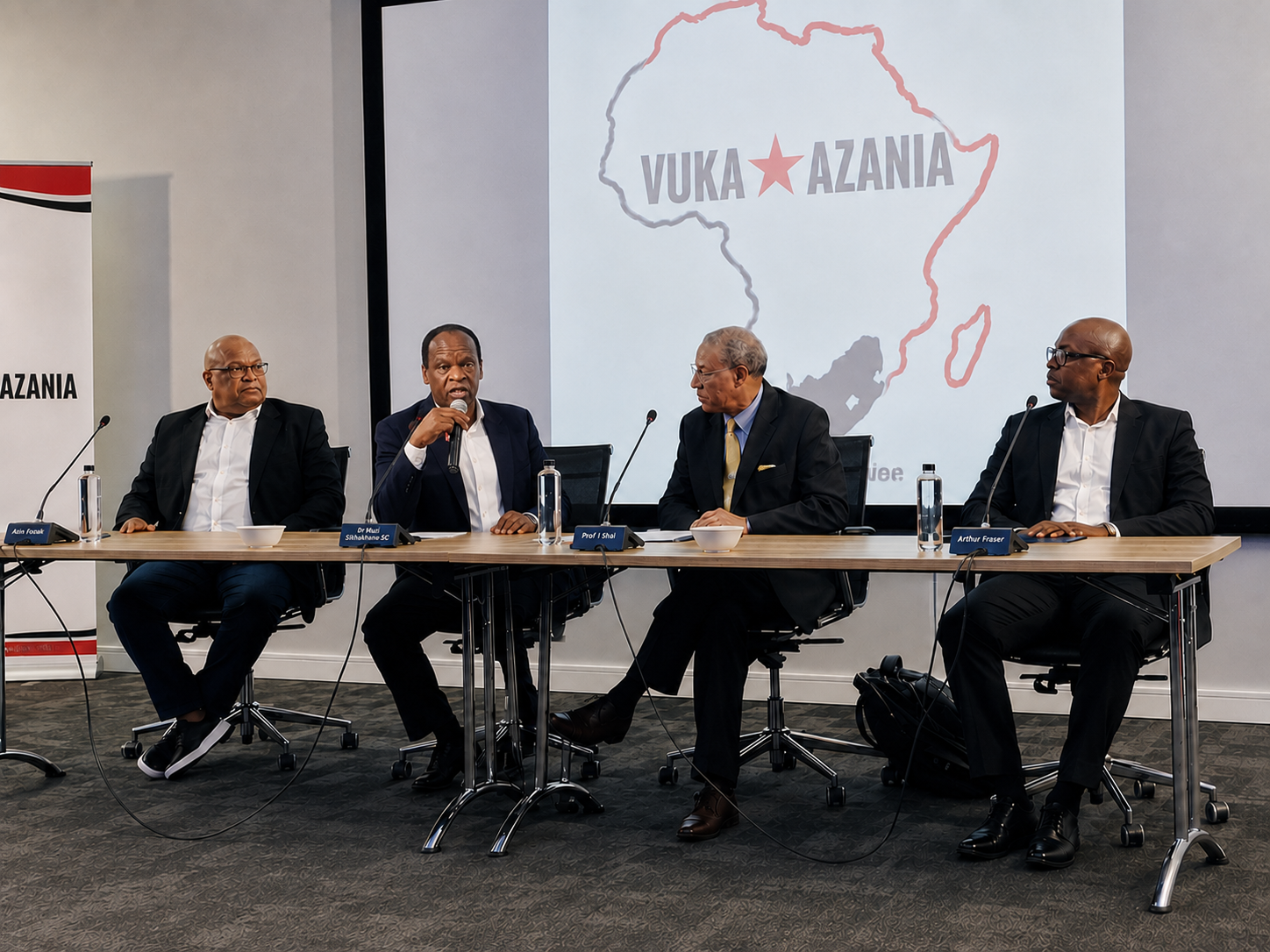
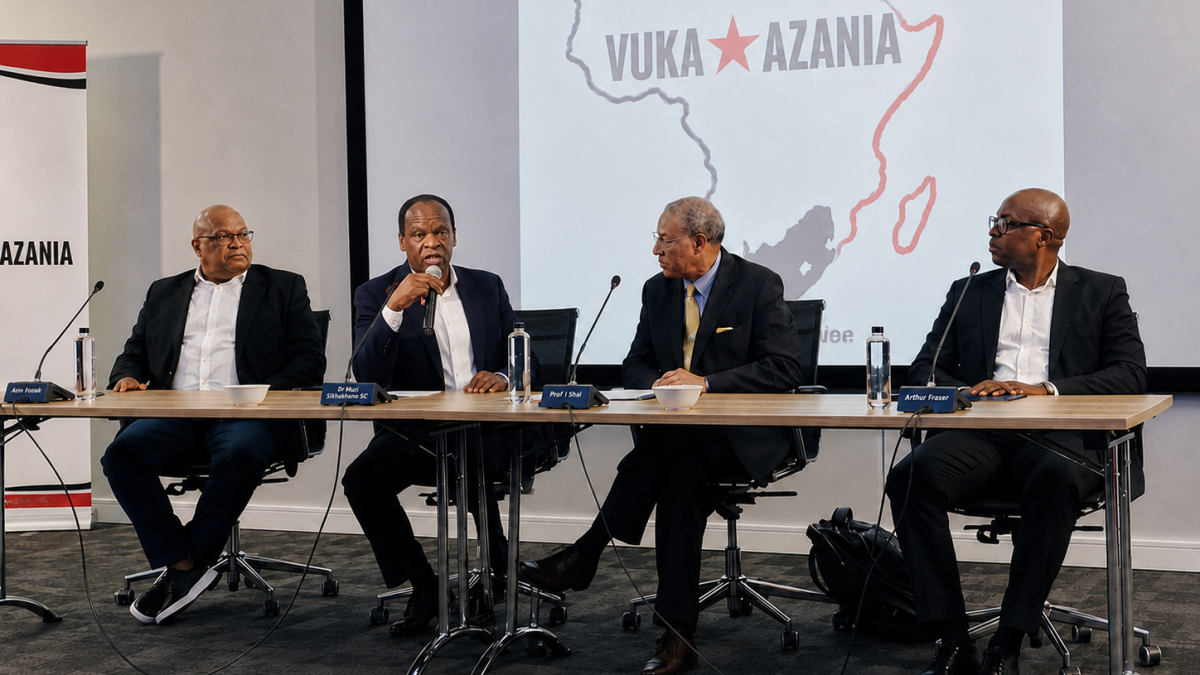
There are moments in the life of a nation when a new organisation arrives not simply to occupy political space, but to recover political purpose. Vuka Azania entered public life at a press briefing in Sandton today, where its founding directors — Dr Muzi Sikhakhane SC, Professor Isaac Shai, Arthur Fraser and Reverend Dr Allan Boesak — formally unveiled the organisation and its vision for the restoration of Black agency, dignity and sovereignty.
The briefing did not announce another non-governmental organisation, policy institute or electoral vehicle competing for parliamentary influence. It introduced a decolonial think tank and advocacy movement committed to completing the work of liberation that remains unfinished more than three decades after the formal end of apartheid.
The presence of all four directors reflected the breadth of the organisation’s political and intellectual foundations. Sikhakhane brought the force of law and constitutional critique; Shai the discipline of scholarship, legal thought and decolonial advocacy; Fraser a history of public service and political struggle; and Boesak the moral authority of liberation theology, anti-apartheid resistance and an enduring commitment to justice.
Together, they presented Vuka Azania as an organisation formed outside the machinery of electoral party politics, but fully engaged with the historical, legal, economic and cultural condition of the country.
Its message landed with unusual force because it spoke directly to a question that has haunted democratic South Africa since 1994: can political freedom be considered complete while the material architecture of colonial conquest remains largely intact?
For Vuka Azania, the answer is unequivocal.
Political rights were indispensable victories won through generations of sacrifice, imprisonment, exile and armed struggle. Yet constitutional democracy did not return the land to its original owners. It did not fundamentally alter patterns of ownership created through conquest. It did not dismantle the economic structures built upon African dispossession, nor did it decolonise education, law or the institutions through which knowledge and power continue to be organised.
The movement therefore begins from a simple proposition: the liberation struggle entered a new phase in 1994; it did not end there.
The significance of Vuka Azania lies precisely in its refusal to accept the prevailing consensus that South Africa’s historical task is now merely to manage inequality more efficiently. Instead, it argues that the nation must once again confront the deeper questions that animated the liberation struggle itself: land, sovereignty, ownership, historical justice and the restoration of African agency.
Those themes shaped the launch itself.
Addressing supporters gathered in Sandton, Senior Counsel Dr Muzi Sikhakhane described Vuka Azania as a movement dedicated to restoring Black dignity and healing a society still carrying the wounds of colonialism and apartheid. Healing, however, was not presented as forgetting history or reconciling oneself to inherited inequalities. Rather, it was understood as the process through which a people recover their confidence, reclaim their historical agency and rebuild the institutions necessary for genuine self-determination.
Equally significant was Sikhakhane’s insistence that Vuka Azania would remain financially independent of interests seeking to redirect or dilute its revolutionary purpose. The organisation, he indicated, would not accept funding that compromised its founding mission. In an era when many civil society organisations are sustained through donor networks whose priorities often shape programmes and public positions, the declaration amounted to more than an administrative commitment. It was a political statement about intellectual sovereignty. A movement committed to decolonisation, Sikhakhane suggested, cannot allow its programme to be disciplined by those invested in preserving the existing order.
That declaration drew a clear distinction between Vuka Azania and much of South Africa’s contemporary NGO sector.
For decades, civil society has played an important role in defending constitutional rights, exposing corruption and expanding access to justice. Yet many organisations have operated within assumptions that treat the post-1994 settlement as fundamentally complete, seeking only to improve its administration or mitigate its failures. Vuka Azania begins elsewhere. It argues that the crisis confronting South Africa is not simply one of governance but of historical continuity. Colonial relations of power survived political transition. The language changed. The constitutional framework changed. The administrators changed. But much of the underlying structure remained.
It is this continuity that the movement seeks to confront.
Its founding declaration places land restoration, African sovereignty, economic justice, legal transformation, cultural renewal and decolonised education at the centre of national reconstruction. These are not presented as isolated policy objectives but as interconnected dimensions of a single historical project: the total emancipation of African people.
The choice of the name itself reflects that ambition.
Vuka is a call to awaken—not merely from political apathy but from the habits of thought produced by centuries of conquest. It summons African people to recover confidence in their own intellectual traditions, historical experience and collective capacity to shape the future.
Azania reaches further still. For generations within the liberation movement, the name has represented more than an alternative geographical designation. It has symbolised a society freed from colonial domination in every sphere of life: political, economic, cultural and psychological. To invoke Azania is to reject the idea that liberation consists solely in occupying institutions inherited from colonial rule. It is to imagine the reconstruction of those institutions from African historical experience.
This distinction runs throughout Vuka Azania’s founding vision.
The organisation does not argue simply for greater Black participation within existing structures. It asks whether those structures themselves continue to reproduce colonial relations. Representation, it insists, cannot be confused with restoration. Access cannot be mistaken for ownership. Inclusion cannot substitute for sovereignty.
Such arguments resonate because they speak to the lived experience of millions of South Africans whose formal citizenship has not translated into material freedom.
The vote was won, yet landlessness remains widespread. Democratic institutions were established, yet the commanding heights of the economy remain concentrated. Schools opened to all, yet educational curricula continue to privilege European intellectual traditions while African systems of knowledge struggle for equal recognition. Constitutional rights expanded, yet unemployment, poverty and inequality continue to fall overwhelmingly upon the Black majority.
For Vuka Azania, these are not unfortunate imperfections within an otherwise completed democratic project. They are evidence that the deeper work of decolonisation remains unfinished.
That analysis recalls an older liberation tradition represented by thinkers such as Steve Biko, Robert Sobukwe and Frantz Fanon, each of whom understood that political domination was sustained not only through legislation but through land dispossession, economic dependency, psychological subordination and cultural erasure. Formal legal equality alone could never undo the historical structures created through conquest.
Vuka Azania places itself squarely within that intellectual lineage while insisting that the challenge before South Africa is now one of reconstruction rather than resistance alone.
Its founders come from different traditions of struggle—law, theology, public service, political organisation and community leadership—but they converge around a shared conviction: that the democratic settlement must now advance beyond political inclusion towards the restoration of African sovereignty in every sphere of national life.
That conviction explains why the movement defines itself not as an electoral party seeking office, but as a vehicle for intellectual renewal, legal intervention, policy development and civic mobilisation. Elections matter, but they cannot by themselves resolve historical questions that long predate democratic transition.
The work before South Africa, Vuka Azania argues, is civilisational.
It requires recovering a people from the long consequences of conquest, rebuilding institutions that serve the majority rather than inherited privilege, and restoring confidence that African people possess both the right and the capacity to determine their own future.
The launch in Sandton therefore represented something larger than the birth of another organisation. It marked the return of a political language that refuses to separate democracy from land, justice from ownership, or freedom from sovereignty.
For those gathered at the launch, Vuka Azania was not announcing the beginning of a struggle.
It was announcing its continuation.