
By Gillian Schutte
Former Israeli military officers, armed security companies, foreign corporate networks and private intelligence operations are embedded in South Africa’s security industry. What authority do these networks exercise over South African security operations, and how is information collected on South African citizens governed?
By Gillian Schutte
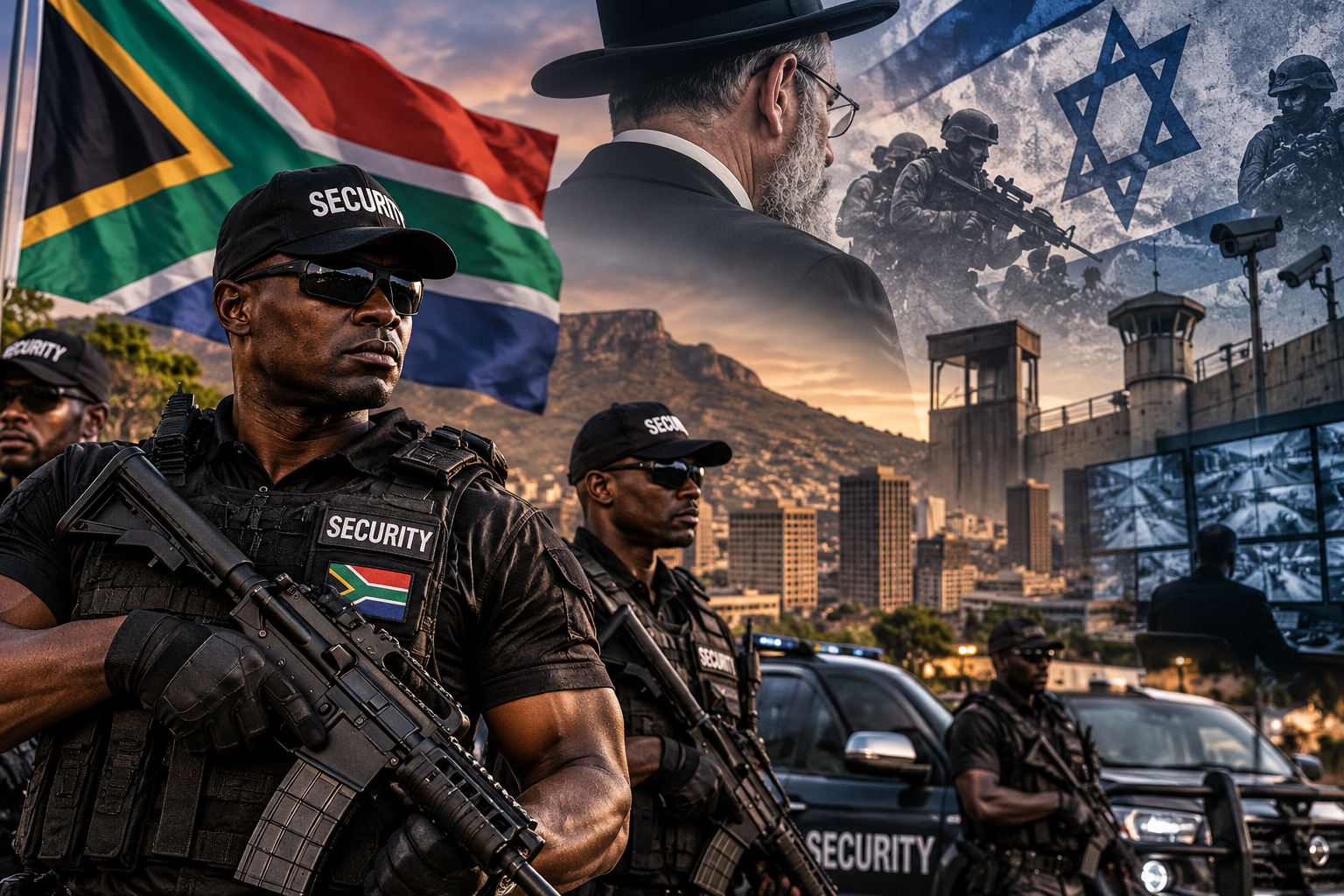
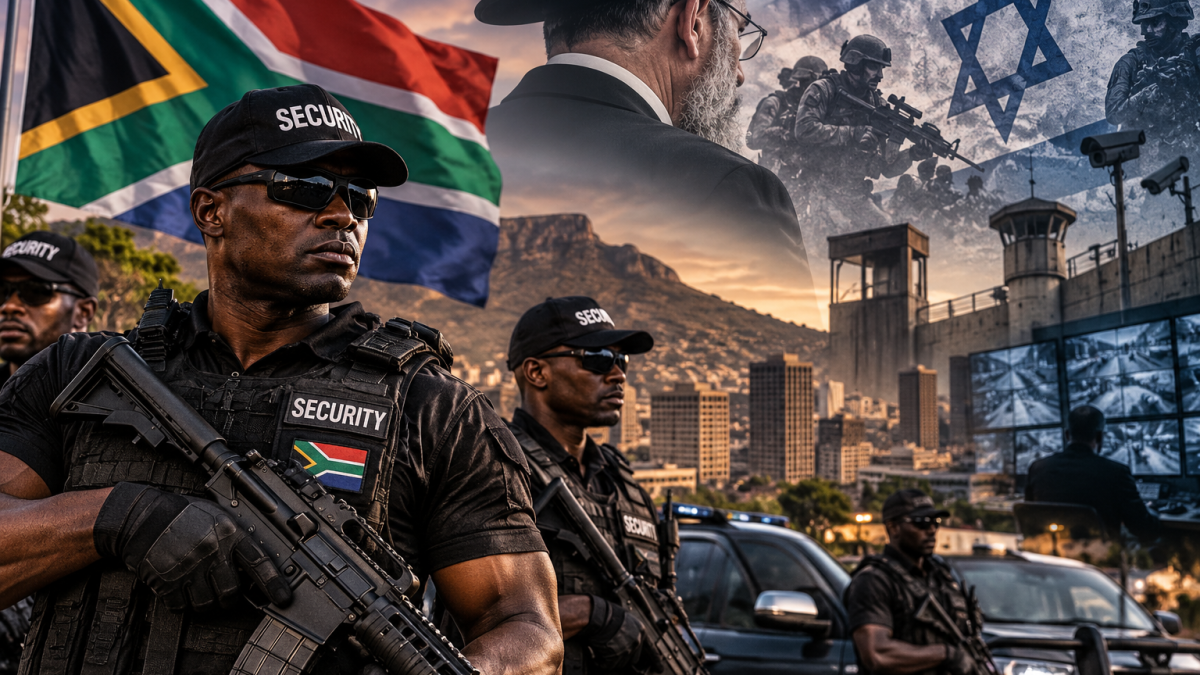
South Africa is confronting an extraordinary contradiction. While its government pursues Israel at the International Court of Justice over genocide in Gaza, security businesses with documented Israeli military and corporate connections operate within the country’s rapidly expanding private security industry.
These businesses offer armed tactical response, intelligence gathering, surveillance, executive protection and specialised security services. Some openly advertise their connections to former Israeli military officers. Others belong to corporate networks headquartered in Israel.
According to the Private Security Industry Regulatory Authority (PSiRA), South Africa had 17,146 active private security businesses and 637,675 active security officers as of March 2025. Private security personnel vastly outnumber the country’s police workforce.
Within this formidable armed industry are companies founded by former Israeli military officers, firms employing personnel trained by former Israeli combat officers and organisations operating sophisticated neighbourhood intelligence systems.
How much of South Africa’s armed private security infrastructure is connected to foreign military networks, and what authority do those networks exercise over South African security operations?
The connections are documented. The full extent of foreign ownership, operational control and access to intelligence remains undisclosed.
CAP: PRIVATE POLICING AND THE ISRAELI MILITARY CONNECTION
Community Active Protection (CAP) was established in Johannesburg in 2006 following an initiative led by South Africa’s Chief Rabbi, Warren Goldstein.
CAP presents itself as a community-owned, non-profit security organisation. Its historical contractor network, however, reveals the presence of extensive international military experience within the policing of Johannesburg’s wealthy suburbs.
In his 2017 book Neoliberal Apartheid: Palestine/Israel and South Africa after 1994, sociologist Andy Clarno investigated CAP and identified three security contractors involved in its operations at the time: Cortac, Quemic and 7-Arrows.
Clarno documented that these contractors were managed by individuals with military backgrounds extending across Israel, South Africa, Italy, Canada and the United States.
His research exposed something deeper about Johannesburg’s privatised policing system. Security companies were developing intelligence operations, coordinating armed patrols and collecting information about people moving through residential neighbourhoods.
CAP’s intelligence infrastructure enabled security information gathered from neighbourhood operations to enter a centralised system.
What information is retained about residents, domestic workers, visitors and people classified as suspicious? What safeguards govern access to these records, and what controls govern their distribution?
Clarno also documented the racial profiling of young Black men within Johannesburg’s private security environment, highlighting the relationship between private policing, property ownership and inherited racial divisions.
These findings concern CAP’s historical operations and contractors. Its current arrangements require fresh investigation.
The evidence nevertheless exposes the growth of private policing institutions that exercise considerable influence over public space while operating through commercial contracts and neighbourhood associations.
In a society shaped by apartheid’s militarised control of Black communities, the expansion of privately administered intelligence and armed patrols raises fundamental questions about constitutional freedoms and public accountability.
MAGEN: AN ISRAELI MILITARY FOUNDER AND A CORPORATE GROUP HEADQUARTERED IN ISRAEL
Magen Protection Services provides one of the clearest documented connections between Israeli military experience and South Africa’s private security industry.
According to its own corporate profile, Magen was founded in Johannesburg in 1994 by a senior Israeli Defence Force general.
The company advertises armed response, executive protection, tactical security, guarding, surveillance and specialised security consulting.
Magen’s website identifies the business as part of the RB-SO Group. RB-SO lists its headquarters in Caesarea, Israel, and includes Magen among its associated businesses.
This places a South African security operation within a corporate network headquartered in Israel. Its precise beneficial ownership and the extent of authority exercised by the parent group require examination of company records.
One particular feature of Magen’s operations deserves attention.
The company advertises an independent intelligence cell supporting its executive protection operations through real-time intelligence analysis.
Here, the convergence of military expertise, armed personnel, surveillance capability and international corporate connections becomes particularly significant.
Where is the intelligence stored? What safeguards govern access to the information? What arrangements govern the transfer of data between South African operations and the wider corporate group?
These questions demand direct answers from the company and South Africa’s security regulators.
The government has an obligation to know exactly which foreign corporate interests exercise authority over security businesses operating within its borders, particularly where armed personnel and private intelligence systems are involved.
FORMER ISRAELI COMBAT OFFICERS ENTER THE SECURITY MARKET
The military connections extend into the marketing of tactical security services.
A published business profile for Johannesburg-based GTS Tactical identifies Tal Sperling as its founder and records his background with CAP Security and the Israeli Defence Force.
The company’s promotional material also describes operations trained and supervised by former Israeli combat officers.
Its present operating status and staffing arrangements still require independent verification.
These corporate descriptions establish that experience acquired in the Israeli military has been used to establish and promote security businesses in South Africa.
They also raise a fundamental regulatory question: how does South Africa assess foreign military backgrounds when granting individuals authority to operate armed security services, supervise tactical personnel and collect intelligence?
The issue extends to training methods, command arrangements, corporate accountability and the relationship between foreign military expertise and domestic security operations.
South Africans are entitled to know who trains private armed units operating in their communities, what tactical methods are being imported and what structures direct those operations.
PARLIAMENT QUESTIONS FOREIGN CONTROL OF PRIVATE SECURITY
These concerns have already reached Parliament.
In March 2026, MK Party MP P. Kubukeli submitted parliamentary questions addressing the national security implications of heavily armed private security businesses.
The questions dealt with specialised weaponry, regulatory controls and the growing capacity of private security organisations to perform functions associated with state security institutions.
Kubukeli also raised concerns about foreign-owned and foreign-controlled security businesses managing biometric systems, access-control networks and licence-plate recognition infrastructure.
A particularly significant question concerned whether the State Security Agency had assessed the possibility of foreign intelligence organisations accessing sensitive South African information through privately managed security technology.
The parliamentary questions constitute formal demands for answers. They are not findings that foreign intelligence penetration has occurred.
Nevertheless, Parliament has identified the same vulnerabilities that emerge from examining Israel-linked security businesses: foreign control, heavily armed operations and access to sensitive information.
What institutions investigate these networks? How thoroughly are their overseas corporate relationships assessed? What arrangements prevent South African security information from entering foreign intelligence systems?
Parliament also raised the implementation of legal measures concerning South African ownership and control of private security businesses.
The government now faces a direct test of its regulatory authority.
FOREIGN COMBATANTS FROM AFRICAN WARS
The problem of foreign military experience within South Africa’s private security sector extends beyond Israel.
A 2015 GroundUp investigation into Cape Town’s nightclub security industry documented the prominence of Congolese nationals working as bouncers.
Institute for Security Studies researcher Khalil Goga confirmed that former soldiers from the Democratic Republic of Congo were working in South Africa.
Industry sources estimated that Congolese nationals accounted for a substantial majority of nightclub bouncers in parts of Cape Town at the time.
Those estimates referred to nationality. They did not establish how many workers had served in armed conflicts.
There is also no verified link between the Congolese former soldiers identified in that investigation and the Israeli-linked companies discussed here.
This creates another line of investigation.
How many former members of foreign armed forces are currently registered with PSiRA? How many served in African conflicts? How are their military backgrounds verified? Which companies employ them, and in what capacities?
South African legislation requires prescribed clearance documentation from applicants who previously served in military, police, security or intelligence organisations, including foreign organisations.
The state has a regulatory framework. The public still lacks a comprehensive account of foreign military personnel working within the security industry and the companies responsible for employing them.
THE PRIVATISATION OF ARMED POWER
South Africa’s private security industry has developed into a vast network of armed patrols, tactical response teams, surveillance systems and private intelligence operations.
Its expansion reflects the country’s crime crisis and the enormous inequalities governing access to personal and property protection.
Affluent suburbs purchase sophisticated security services, intelligence coordination and dedicated armed patrols. Working-class communities remain dependent upon public policing institutions struggling with inadequate resources, corruption and operational failures.
This arrangement has profound class consequences.
The wealthy increasingly purchase their own security infrastructure, while private companies gain influence over the management of neighbourhoods, public-facing spaces and the movement of people through them.
Foreign military expertise enters an industry already shaped by unequal property relations and the commercialisation of public safety.
The presence of Israeli military experience within sections of this industry therefore requires examination within South Africa’s broader political economy.
Who benefits from privatised armed protection? Who finances the organisations? Which communities are subjected to surveillance? What institutions govern the information gathered through these operations?
The questions extend directly to foreign ownership and international corporate relationships.
ARE PRIVATE ARMIES BEING BUILT?
A private army involves an organised armed force operating through command structures outside the state’s lawful military authority.
South Africa’s Constitution establishes the national defence force as the country’s only lawful military force. Licensed security companies operate under separate legislation and regulatory requirements.
The available evidence identifies Israeli military and corporate connections within South Africa’s private security sector. It has not established a unified Israeli-directed military organisation operating through these companies.
The evidence has, however, revealed an extensive private security industry in which armed capabilities, intelligence systems and international military expertise intersect.
That demands a comprehensive public investigation into the ownership, financing, training arrangements and command structures of foreign-linked security businesses.
PSiRA, the State Security Agency and the relevant parliamentary committees need to establish exactly how many private security companies have foreign beneficial owners, how many employ former foreign military personnel, and what safeguards govern their surveillance and intelligence activities.
They also need to establish whether any security businesses have operational or contractual relationships with foreign military, intelligence or defence institutions.
These findings should be made public.
South Africa’s sovereignty extends beyond its diplomatic positions and international legal commitments. It includes control over armed force, sensitive information, critical infrastructure and the security of its population.
A country challenging Israel’s conduct in international courts has every reason to investigate the extent of Israeli-linked military and security networks operating within its own economy.
What safeguards govern these companies? Who trains their armed personnel? Who controls their intelligence? Who receives their data? And what authority ultimately governs their operations?
These are questions the South African government needs to answer.
The country cannot afford to leave the ownership and command of its expanding private security apparatus hidden behind corporate registrations, international partnerships and commercial confidentiality.
South Africans must demand to know in whose hands the guns are held, who controls the information and why foreign military interests are acquiring influence over the security of their country.