
By Gillian Schutte
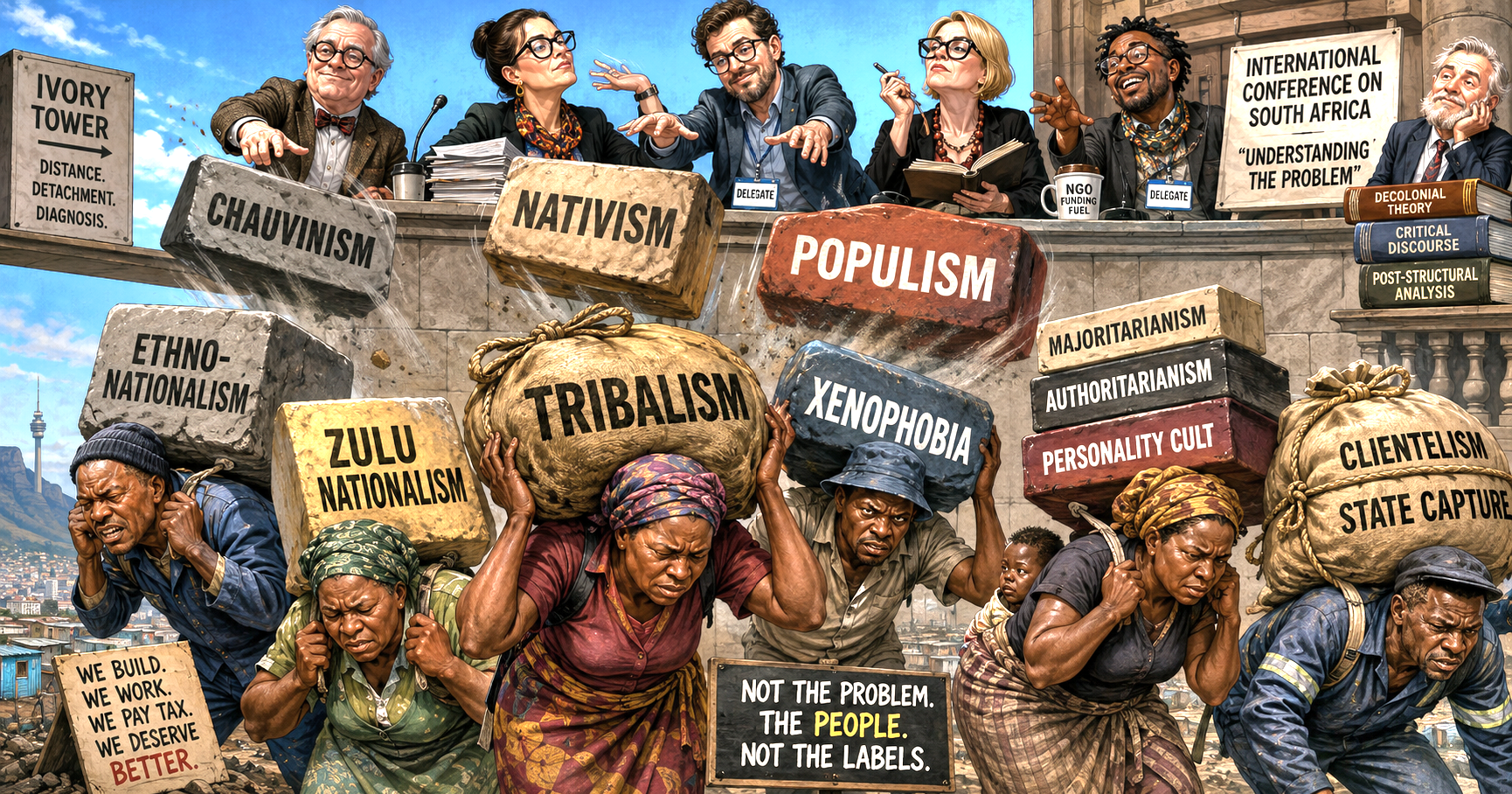
There is a small but exceptionally industrious class of South African progressive intellectuals whose central occupation appears to be diagnosing political illnesses among people they have never met.
Let Black citizens gather outside a government building and demand land, jobs, functioning borders, affordable electricity or economic sovereignty, and somewhere an academic laptop immediately begins to glow.
Within minutes, the nation is warned of populism.
If the crowd grows, it becomes nativism.
If somebody sings, it advances to ethno-nationalism.
If the song happens to be in isiZulu, the diagnosis is upgraded to Zulu nationalism.
Should an elderly woman raise a walking stick, the country has entered the early stages of authoritarian nationalism.
By sunset, somebody has detected fascism.
This is the disciplinary conveyor belt of the NGO-liberal left:
National consciousness → nationalism → nativism → chauvinism → xenophobia → authoritarianism → fascism.
Each word adds another siren, another webinar and another grant application.
By nightfall, the mobilisation has been diagnosed as narrow nationalism, exclusionary nationalism, ethnic nationalism, racial nationalism, reactionary nationalism, predatory nationalism and possibly patriarchal ethno-nationalism.
The people themselves may have thought they were asking why the local clinic has no medicine.
They were mistaken.
They are participating in right-wing populism.
The Emergency Webinar
The webinar title will be something like:
“From Democratic Discontent to Subaltern Chauvinism: Interrogating the Proto-Fascist Grammar of Post-Liberation Majoritarian Affect.”
Nobody knows what this means, including the panellists, but everyone agrees it is deeply concerning.
The event opens with a land acknowledgement, a donor acknowledgement and an acknowledgement that the Wi-Fi is unstable because of neoliberalism.
Paddy has detected a populist edge.
Dale has identified chauvinism.
A senior researcher has discovered nativist populism in a voice note sent by a grandmother in KwaMashu.
A visiting fellow warns of ethnic chauvinism.
Someone from an institute in Cape Town raises the possibility of Zulu chauvinism.
An NGO director reports signs of xenophobic nationalism.
A doctoral candidate sitting in Rosebank identifies reactionary majoritarianism among residents of a shack settlement who have failed to acquire a sufficiently transnational understanding of informal retail competition.
By the second hour, the gathering has been classified as authoritarian populism, populist demagoguery, predatory and authoritarian nationalism, and that deadliest of political conditions: sinister ethnic nationalism and radicalism.
The dispossessed people under discussion are absent, naturally. Their presence might introduce history, material conditions or an improper tone.
The NGO professoriat prefers the dispossessed in theory. Actual dispossessed people interrupt. They reject the approved vocabulary. They arrive carrying demands rather than funding proposals.
They may even ask who invited the panellists to speak on their behalf.
Such behaviour reveals a disturbing hostility towards expertise.
An Outbreak of Chauvinism
Chauvinism describes an exaggerated belief in the superiority of one’s own group. Few classes display greater faith in their intellectual superiority than the progressive NGO-academic caste.
Its language is sophisticated.
Everybody else’s language is dangerous.
Its anger is analysis.
Popular anger is resentment.
Its networks are civil society.
Everybody else’s networks are clientelism.
Its political loyalties are principled.
Everybody else belongs to a personality cult.
Its foreign funding represents international solidarity.
Foreign relationships outside the Western donor system provoke concerns about interference.
Its identity politics is intersectional.
Black majority politics is tribalism.
Its favoured leaders possess moral authority.
Popular leaders represent strongman politics, cult politics and the menacing return of the Big Man.
This is apparently neither institutional chauvinism nor intellectual chauvinism.
It is peer review.
Seminar-Room Nativism
The NGO professoriat regularly condemns people who derive political authority from belonging. Yet it fiercely protects its own native territory: the panel discussion, policy workshop, donor-funded journal, university department and newspaper opinion page.
Entry requires the correct accent, citations and ritual phrases.
Before admission, one must declare that every crisis is complex, every border is colonial, every mass mobilisation is vulnerable to manipulation and every working-class person expressing anger requires facilitation.
International border posts have less demanding entry requirements than progressive civil society.
A traveller may cross three countries without documentation more easily than a township organiser can enter a donor symposium without saying “intersectional framework” before lunch.
This is seminar-room nativism: the belief that legitimate political speech belongs naturally to those indigenous to the conference circuit.
Those who have lived through a crisis supply testimony.
Those who have studied it supply meaning.
Populism in the Annual Report
We are told that populism uses emotionally satisfying language, divides society into virtuous and corrupt camps, simplifies complicated questions and flatters an intended audience.
This sounds remarkably similar to an NGO annual report.
There, the world is divided between courageous activists and dangerous demagogues, resilient communities and shadowy populists, progressive civil society and regressive masses.
Every programme is transformative.
Every workshop empowers.
Every dialogue amplifies.
Every report centres.
Every consultant facilitates.
After three years and R14 million, twelve people have received tote bags, twenty-seven have been capacitated and the structural crisis has renewed its contract for another funding cycle.
Still, the brochure photographs are magnificent.
The NGO annual report may be the purest surviving form of populist demagoguery. It tells funders exactly what they want to hear, divides the world into enlightened donors and endangered beneficiaries, turns institutional ambition into moral urgency and promises transformation without disturbing the political economy that makes the organisation necessary.
This is called sustainability.
The Tribes of Progressive Thought
The charge of tribalism is especially entertaining.
Academia contains tribes so territorial that medieval clans appear cosmopolitan.
There are Marxist tribes, post-Marxist tribes, neo-Marxist tribes and former Marxists who migrated into decolonial consultancy.
There are Trotskyists who have not forgiven Stalin since 1927, liberals who identify as radicals during conferences and postcolonial theorists who refuse to sit beside political economists unless the moderator was educated in Europe.
Each tribe has ancestors, sacred texts, protected territories and ritual insults.
One group cites Fanon.
Another accuses the first of misreading Fanon.
A third explains that Fanon can only be understood through affect theory.
A fourth secures the grant.
This is called intellectual diversity.
When ordinary people form political loyalties around history, culture, language or shared experience, it becomes ethnic mobilisation.
When academics organise themselves around journals, departments, citation circles and funding networks, it becomes a school of thought.
Lexical Authoritarianism
Then we reach authoritarianism.
Who decides which demands may be expressed without condemnation?
Who determines the permitted words for discussing migration, borders, land, sovereignty, citizenship and township economies?
Who imposes moral penalties when citizens use an unapproved term?
Who converts political disagreement into evidence of pathology?
The NGO professoriat has constructed a complete border-management system around public speech.
Certain phrases are stamped and admitted.
Others are detained for questioning.
“Human mobility” passes freely.
“Controlled borders” is escorted into a small room.
“Pan-African solidarity” receives a multi-entry visa.
“Citizenship obligations” is strip-searched.
“Township economic displacement” is deported for sounding dangerously close to lived experience.
“Sovereignty” is placed on a watchlist.
“Economic nationalism” is denied entry.
“Majority rule” is referred to a specialist in anti-constitutionalism.
This is lexical authoritarianism: rule through approved terminology, administered by self-appointed customs officials of respectable thought.
The same people then warn everyone else about authoritarian populism.
The Cult of the Anti-Cult Expert
The NGO professoriat is deeply troubled by strongman politics, cult politics and the personality cult.
It therefore organises a conference around one visiting professor whose biography requires fifteen minutes to read.
The keynote speaker is introduced as a scholar, activist, public intellectual, global thought leader, movement elder, critical pedagogue and pioneer of transformative epistemologies.
Everyone rises.
The professor’s latest book is displayed like scripture.
Nobody may ask why the keynote fee exceeds the annual budget of the community project being discussed.
A politician followed by thousands of dispossessed citizens is practising personality politics.
An academic followed from conference to conference by the same reverent postgraduate students is building a critical intellectual tradition.
One appears on a campaign poster.
The other appears on the cover of a special journal edition devoted to his own thought.
Progressive Patriarchy
Then there is patriarchal politics.
The progressive sector condemns patriarchal authority while producing a remarkable number of permanent male executive directors, founding chairpersons, senior fellows and movement elders who have occupied their positions since the fax machine.
These men speak continuously about creating space.
The space is usually created beside them.
Women perform the administration, community liaison, emotional labour, transcription, research and crisis management while the movement elder explains patriarchal ethno-nationalism to an international audience.
His organisation’s succession plan remains under development.
His assistant has been underpaid since 2014.
This, too, is structural.
Patronage with Better Stationery
Patronage politics, we are told, occurs when loyalty is rewarded through access to money, status and opportunity.
In the NGO sector, loyalty is rewarded through fellowships, residencies, research contracts, advisory positions, media columns, conference invitations, visiting scholarships and consultancies titled “strategic knowledge partnership”.
This is entirely different because the payment comes from a foundation.
A politician gives a supporter a municipal contract and it is clientelism.
A donor gives the same twelve commentators every available platform and it is capacity building.
A party deploys cadres.
A university develops cohorts.
A government rewards loyalists.
An NGO remunerates experts.
A political faction distributes tenders.
A progressive network circulates opportunities.
One wears a party T-shirt.
The other wears a lanyard.
The state has patronage networks. Civil society has mailing lists.
The Community Leader as Fundraising Persona
Occasionally the NGO sector discovers a powerful community leader whose authority was built through years of work among his family and his people.
He knows who faces eviction, whose electricity was disconnected, which child was arrested and which official has been lying. His politics has roots, memory and consequences.
This presents an irresistible fundraising opportunity.
He is plucked from that work and improved.
His anger becomes a “concern”.
His people become an “affected community”.
His demands become “advocacy objectives”.
His political conclusions acquire nuance.
Soon he is travelling between conferences to explain suffering he has less time to organise against.
His history, wounds and credibility become institutional assets. His biography opens the funding proposal. His face authenticates the annual report. His distance from the people grows with every fellowship.
What better fundraising persona than Malume Tom?
The community produced the struggle, courage and legitimacy.
Civil society supplied the lanyard.
Xenophobia at the Atlantic Terminal
The greatest comedy remains xenophobia.
The progressive intellectual class exhibits an extraordinary fear of ideas originating beyond its familiar ideological geography.
Mention Russia, China, Cuba, Iran, Venezuela or the Sahel and the room develops an allergic reaction.
People who insist that borders should never impede the movement of labour become remarkably enthusiastic about policing the movement of political thought.
Western theories may enter freely.
Western money may enter freely.
Western NGOs may enter freely.
Western diplomats may enter freely.
Western talking points pass through customs with nothing to declare.
An African government expressing an independent geopolitical preference is immediately suspected of contamination.
This is epistemic xenophobia: hostility towards political ideas arriving from outside the approved Atlantic terminal.
The NGO professoriat’s intellectual border is open to capital, consultants and foundations.
It closes abruptly when sovereignty approaches.
Majoritarianism, the Great Terror
Then there is majoritarianism, perhaps the most alarming condition of all.
The NGO professoriat distrusts the political weight of majorities, especially when those majorities are Black, organised and unwilling to be mediated.
A Black majority demanding control over land and resources is accused of reactionary majoritarianism.
A collection of six NGOs, four columnists, three professors and one European foundation agreeing on a term is called national consensus.
The population need not be consulted.
The webinar has spoken.
Popular mobilisation is described as racial nationalism. Minority elite coordination is described as constitutionalism.
A majority insisting that democracy should have material consequences is accused of social conservatism, anti-constitutionalism, radicalism or insurrectionary politics.
A foundation attempting to influence national policy through unelected professional networks is practising advocacy.
State Capture for People with Conference Badge
The NGO professoriat is understandably fascinated by state capture.
It has produced reports, conferences, commissions, dashboards, podcasts and colour-coded flow charts showing how political networks influence public institutions.
Less attention is paid to the quieter capture of public debate by donor-funded organisations, foundation-supported media, recurring experts and interlocking advisory boards.
Political capture leaves fingerprints on tenders.
Ideological capture leaves footnotes.
One arrives through procurement.
The other arrives through the language of best practice.
The kleptocracy of political elites steals public money.
The professional knowledge economy extracts public experience, repackages it as expertise and sells it to institutions that can afford the consultant’s fee.
One takes the budget.
The other takes the narrative.
The RET Emergency
No contemporary diagnostic exercise would be complete without RET populism.
The phrase performs valuable intellectual labour. It gathers land hunger, anger at monopoly capital, resentment towards elite institutions, demands for state intervention, Black economic aspiration, factional manoeuvring, opportunism and criminality into one convenient container.
Once the label is applied, no distinction is required.
Every demand for redistribution can be treated as camouflage for kleptocracy.
Every attack on entrenched capital becomes demagoguery.
Every criticism of liberal institutions becomes anti-constitutionalism.
Every popular leader becomes a strongman.
Every crowd becomes a cult.
Every expression of African nationalism slides towards sinister ethnic nationalism and radicalism.
The analysis arrives fully assembled.
Material inquiry is unnecessary.
The Next Conference
Perhaps the next progressive symposium should turn this magnificent diagnostic apparatus inward.
Its title could be:
“Confronting Our Own Donor-Funded Chauvinism: A Decolonial Inquiry into the People Who Keep Calling Everybody Else Nativist.”
The programme could include:
Seminar-Room Nativism and the Territorial Defence of the Panel Discussion
Grant-Funded Populism and the Emotional Grammar of the Annual Report
Citation Tribalism in Contested Academic Ecologies
Foundation Patronage and the Clientelist Distribution of Fellowships
Lexical Authoritarianism and the Policing of Popular Speech
Epistemic Xenophobia at the Atlantic Terminal
Strongman Politics in the Office of the Permanent Founding Director
The Personality Cult of the Visiting Global Thought Leader
Progressive Patriarchy and the Movement Elder Who Will Never Retire
The Extraction of Community Leadership as Donor-Facing Authenticity
NGO State Capture and the Privatisation of Public Meaning
The closing panel could ask whether the NGO professoriat’s own culture displays chauvinism, nativism, populism, ethno-nationalism, tribalism, authoritarianism, identity politics, patronage politics, social conservatism, anti-constitutionalism, demagoguery and a mild but persistent form of cult politics.
There would be one difficulty.
After applying its preferred vocabulary to itself, the NGO professoriat might discover that it has spent years issuing warnings about its own reflection.
At which point the facilitator would announce that the session had run out of time.
The findings would require further research.
Participants would be invited to continue the conversation online.
Funding permitting.