

By: Gillian Schutte
The confusion begins when the language used to describe a contradiction conceals the forces that created it.
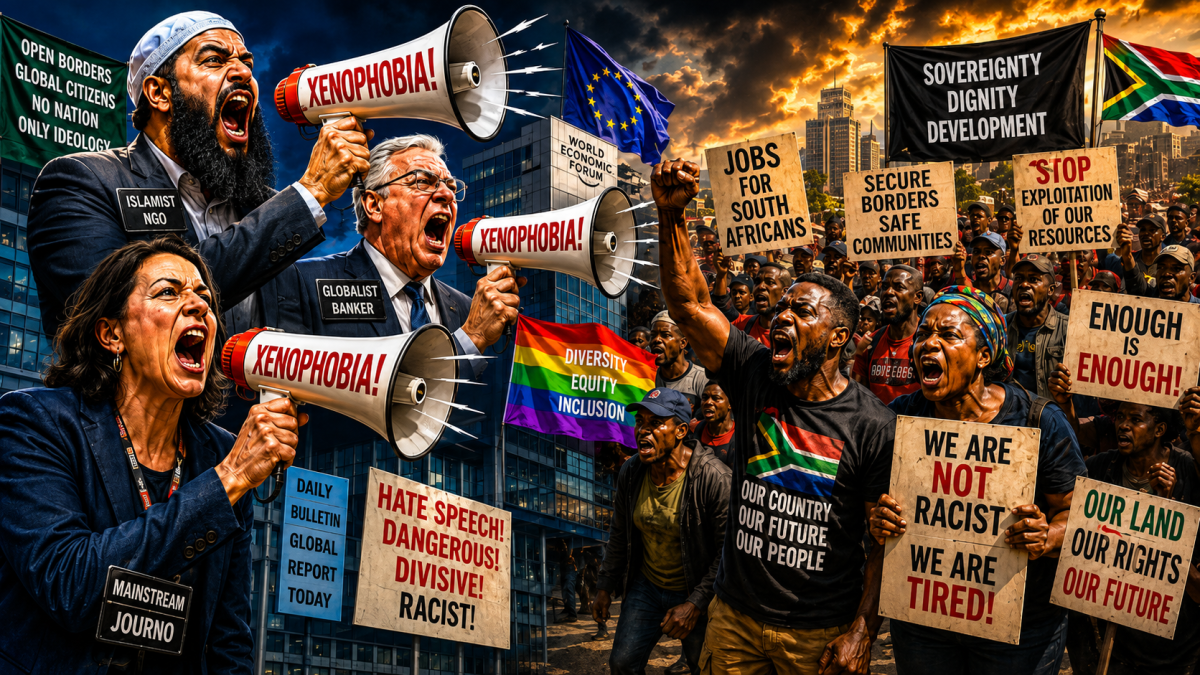
They call the crisis “xenophobia” because the word arrests thought at the level of attitude. It tells us that the problem lives inside the African masses: in their ignorance, intolerance, anger or moral failure. Once that diagnosis is accepted, the prescribed response follows automatically: educate the people, correct their thinking, monitor their conduct and discipline their anger. Workshops are organised, campaigns funded and experts dispatched to explain tolerance to communities whose daily lives are shaped by unemployment, dispossession, overcrowding, collapsing services and economic insecurity.
This is dialectical confusion because it mistakes the visible expression of the contradiction for its determining cause.
The struggle is presented as a conflict between a South African worker and an African migrant, between a township trader and a foreign trader, between one dispossessed community and another. Yet neither group designed the economic order in which they are compelled to compete. Neither controls the borders, the labour market, the ownership of land, the distribution of public resources or the movement of capital. The antagonism appears at the bottom, while its organisation occurs above.
Capital benefits from vulnerable labour. Employers gain when workers can be hired cheaply, threatened with exposure, denied legal protection and replaced without resistance. Political elites feel safe when anger travels horizontally between communities rather than vertically towards the state and the owning class. The professional NGO sector is richly rewarded when the crisis can be translated into funded programmes concerning tolerance, social cohesion and migrant integration. The media is fed from a moral drama in which villains and victims have already been assigned.
The one per cent survives through this fragmentation.
This does not require every journalist, academic or NGO worker to understand the function they are performing. Some are sincere. Some genuinely believe they are protecting vulnerable people. Yet sincerity does not abolish political consequence. A person may oppose cruelty while reproducing an analysis that shields the structure responsible for the suffering.
Funding shapes consciousness. Institutions learn the vocabulary that opens doors. Researchers know which questions attract grants. Journalists understand which experts are considered respectable. Activists gravitate to campaigns that receive international recognition and off-shoot career opportunities. Over time, the donor’s framework begins to appear like common sense. The language of class, sovereignty, ownership, labour discipline and economic reconstruction is pushed aside by the language of attitudes, prejudice and inclusion.
The moral framing is attractive because it offers the professional class a clean political identity. It allows them to stand before the public as defenders of vulnerable migrants while avoiding confrontation with employers, corporations, financial institutions and governments. They then denounce the anger of township residents without examining the economic order that produced it. They speak passionately about prejudice while remaining silent about the material arrangements that force dispossessed populations into competition.
The deeper questions are avoided because they lead towards a confrontation with power.
Who destroyed industrial employment? Who benefits from undocumented and underpaid labour? Who allowed township economies to remain weak and unprotected? Who preserved the concentration of land and wealth after apartheid? Who expects working-class communities to absorb expanding social pressure while clinics, schools, housing and infrastructure remain inadequate? Who profits from the regional inequalities that force Africans to leave their countries in search of survival?
These questions belong in relation to governments, corporations, financial institutions and the owning class. Instead, they are shouted at protestors as moral accusations, as though the dispossessed African majority created the order under which it struggles to survive.
Responsibility is pushed downwards. Township residents are commanded to answer for deindustrialisation, unemployment, collapsing public services, undocumented labour and continental displacement, while the NGO professional class performs the role of principled opposition. In reality, it stands securely within the order it claims to challenge. It receives funding through its institutions, speaks its authorised language, circulates within its conferences and preserves the boundaries of acceptable dissent.
This is the dialectical deception. The questions themselves reveal the relationship between imperialism, comprador elites, capital and the dispossessed African majority, yet they are placed before people who possess neither the political power nor the institutional authority to resolve them.
Migration cannot be separated from sanctions, structural adjustment, deindustrialisation, unequal trade, resource extraction, war and the organised underdevelopment of African states. South African working-class anger cannot be separated from the unfinished struggle over land, ownership, employment and sovereignty. The same global order that weakens African productive economies and displaces workers across borders supplies capital with a labour force made vulnerable by desperation and undocumented status.
Local and migrant communities are then concentrated inside the same zones of scarcity. They compete for jobs, accommodation, trading space, schools, clinics and basic services. Having produced the contradiction, the ruling order sends its professional intermediaries into those communities to condemn the people trapped inside it.
The word “xenophobia” interrupts the investigation at the point where power would otherwise become visible. Political economy is replaced by sanctimonious accusation. The dispossessed Black South African majority becomes the object of suspicion. The wealthy become observers of the wreckage they profit from. The state becomes a commentator on a crisis it helped create. Capital disappears completely.
Were the NGO professional class genuinely confronting power, its analysis would begin with the destruction of African productive capacity, the preservation of colonial patterns of ownership, the role of comprador governments and the economic value of labour made cheap through desperation and legal insecurity. It would confront the corporations, states and financial institutions that profit from the circulation of precarious labour across the continent.
It would demand to know why Black South African communities, still dispossessed of land, capital and productive sovereignty, are expected to carry the social costs of continental crisis while housing, schools, clinics and infrastructure remain starved of capacity. It would expose employers who use undocumented workers to suppress wages and weaken collective organisation. It would challenge states that neglect border administration, labour enforcement and documentation, then accuse communities of moral failure when the consequences become impossible to ignore.
Instead, structural questions are carried into the township and thrown at protestors. The NGO professional behaves as though the dispossessed have failed to confront capital while carefully avoiding any confrontation that could threaten capital’s authority. They cannot bite the hand that feeds them, so they command the dispossessed to bite it on their behalf, then condemn them for the form their anger assumes.
The people at the bottom are expected to solve contradictions organised from above. They are told to remain endlessly accommodating while their economic position deteriorates. They are required to absorb every failure of the state, every regional crisis and every consequence of unequal development without raising questions about capacity, sovereignty or social protection. When they do raise those questions, the professional class approaches them as a dangerous population requiring correction.
Violence against migrants demands unequivocal opposition. No African liberation politics can accept the beating, killing or persecution of another African. Yet opposition to violence cannot require intellectual surrender. It cannot mean that every demand for lawful immigration, regulated borders, labour protection, functioning documentation or the defence of township livelihoods is condemned as hatred.
A dialectical understanding holds both realities together. Migrants can be vulnerable to exploitation and abuse while working-class South Africans remain victims of an economic order that treats their communities as dumping grounds for unresolved regional contradictions. Employers can exploit undocumented migrants while political elites accuse local workers of intolerance. The state can abandon its responsibilities and then criminalise communities for recognising the consequences of that abandonment.
The confusion is useful because it divides those who should be organised against the same system.
The migrant worker is told that the South African worker is the enemy. The South African worker is encouraged to see the migrant as the source of unemployment and scarcity. Both are prevented from identifying the class that benefits from cheap labour, informalised employment, weak enforcement and permanent insecurity.
The ruling class has no difficulty tolerating humanitarian outrage that leaves ownership intact. It can finance social-cohesion programmes, sponsor conferences and celebrate diversity while continuing to extract wealth from fragmented workers. It can condemn hostility between African communities while profiting from the conditions that produce that hostility. It can present itself as enlightened because it has financed the vocabulary through which its own responsibility disappears.
This is how the one per cent protects itself. It turns class war into social conflict among the dispossessed. It finances the language that names the symptoms and conceals the structure. It directs moral outrage towards the township while wealth, ownership and imperial power remain beyond interrogation.
The professional NGO class experiences this arrangement as benevolence because its consciousness has been shaped by the institutions through which it receives status, income and recognition. It believes proximity to elite foundations gives it influence over power. In practice, power often grants it influence only over the language in which suffering may be discussed. It may speak about tolerance, diversity, inclusion and social cohesion. The language becomes guarded and evasive when discussion turns towards land, wages, borders, ownership, sovereignty and the organised political power of the African majority.
Its compassion therefore travels downwards. It lectures the township, educates the worker and diagnoses the dispossessed. It approaches the billionaire as a philanthropist, the donor as a partner, the corporation as a stakeholder and the state as an institution lacking capacity. Only the African majority is placed in the dock.
It is easier for this class to turn on Black South Africans because the African majority is the population upon whose continued dispossession its own respectability rests. Its salaries, institutions, conferences, consultancies and moral authority require a permanent constituency to manage, interpret, diagnose and discipline. A sovereign, organised and economically secure Black majority would have little need for this mediation. It would expose the NGO professional as a broker between wealth and suffering, useful to the ruling order because rebellion is converted into programmes, anger into reports and political demands into donor-approved interventions.
The entire professional identity depends upon standing between the people and power. For this arrangement to survive, the people have to remain sufficiently wounded to require representation, sufficiently fragmented to require mediation and sufficiently disorganised to remain dependent on experts. Their suffering provides the raw material from which professional authority is produced.
This is why Black South African anger provokes such intense acrimony. The anger threatens to escape the authorised vocabulary. It points towards ownership, borders, labour, land and sovereignty. It refuses the assigned role of passive victimhood. It begins to name the people who manage suffering without ending it.
At that point the NGO professional experiences the African majority as a danger. The majority is feared because it may begin speaking for itself, defining its own interests and rejecting the intermediaries who have built careers around its wounds. A population that develops political clarity no longer requires a class of interpreters to explain its pain to power.
Their hostility may then contain something deeper than political disagreement. It may express the subconscious guilt of a class that senses its comfort is tied to the continued degradation of those it lectures. Somewhere beneath the language of humanitarian concern lies an unbearable recognition: their own security exists alongside the insecurity of the majority, and their professional importance grows from conditions they have failed to transform.
Unable to confront the source of this privilege, they project their anxiety onto the dispossessed. Black anger is recast as pathology. Black political organisation is treated as menace. Demands for sovereignty are described as intolerance. The majority is made to appear morally defective because that conclusion protects the professional class from examining its own location inside the architecture of power.
The harsher the condemnation, the more urgently it attempts to silence the knowledge it carries within itself: that without a wounded African majority beneath it, its careers, status and moral authority would begin to collapse. Its acrimony towards Black South Africans therefore functions as a defence of its own social position. It requires the majority to remain dispossessed enough to be managed, fragmented enough to be spoken for and politically contained enough never to overturn the order that gives the professional class its place above them.
Our task is to end the confusion by recognising the dispossessed Black South African poor as political subjects with the right to name their own condition, define their own interests and act in defence of their communities. Enforce labour law, restore sovereignty, rebuild productive economies and confront the class that profits from unemployment, landlessness and insecurity. Until you are prepared to face those realities, take the word “xenophobia” out of your mouth.



[581421]supplies professional anti-violence equipments and solutions for the whole world with strong and perfect production capacity. anti-violence.org
Закажите качественный ремонт в ванной в новостройке с учетом планировки и ваших пожеланий. Подберите отделочные материалы, сантехнику и дизайн, чтобы обустроить удобное, функциональное и современное пространство.
expertoption review rsi strategy binary options
снос и демонтаж зданий и сооружений https://snos-zdaniy-spb.ru
Нужны чеки? купить чеки задним числом для бизнеса и физ. лиц. Чеки для отчетности ОФД, ККМ, ККТ. Реальные операции, гарантии оригинальности!
онлайн-журнал https://pedia.com.ua для тех, кто интересуется современным образом жизни, здоровьем и саморазвитием. Полезные статьи о семье, воспитании детей, красоте, домашнем хозяйстве, садоводстве, технологиях и повседневных вопросах. Новые идеи, советы и интересные материалы для широкой аудитории.
Ищете отель на час https://spb.60minut.ru в Санкт-Петербурге? Ознакомьтесь с гостиницами и апартаментами с почасовой оплатой, сравните цены, расположение и условия проживания. Подберите номер для отдыха, деловой встречи или остановки между поездками. Удобные варианты краткосрочной аренды жилья.
pocket option strategy 1 minute binary options trading
martingale strategy binary options binary options withdrawal to nigerian bank account
снос и демонтаж зданий и сооружений демонтаж каркасного здания