
By Gillian Schutte
Olivier Assayas’s The Wizard of the Kremlin fancies itself an inquiry into Russian propaganda. Its ideological work begins in that posture but ultimately invites the viewer to examine Russia’s manufacture of political reality while leaving the Western machinery of political influence largely outside the frame. Its foundations, NGOs, election programmes, media funding, universities and democracy-promotion networks appear as ordinary features of liberal international life. Russian political communication, by contrast, is repeatedly coded as manipulation.
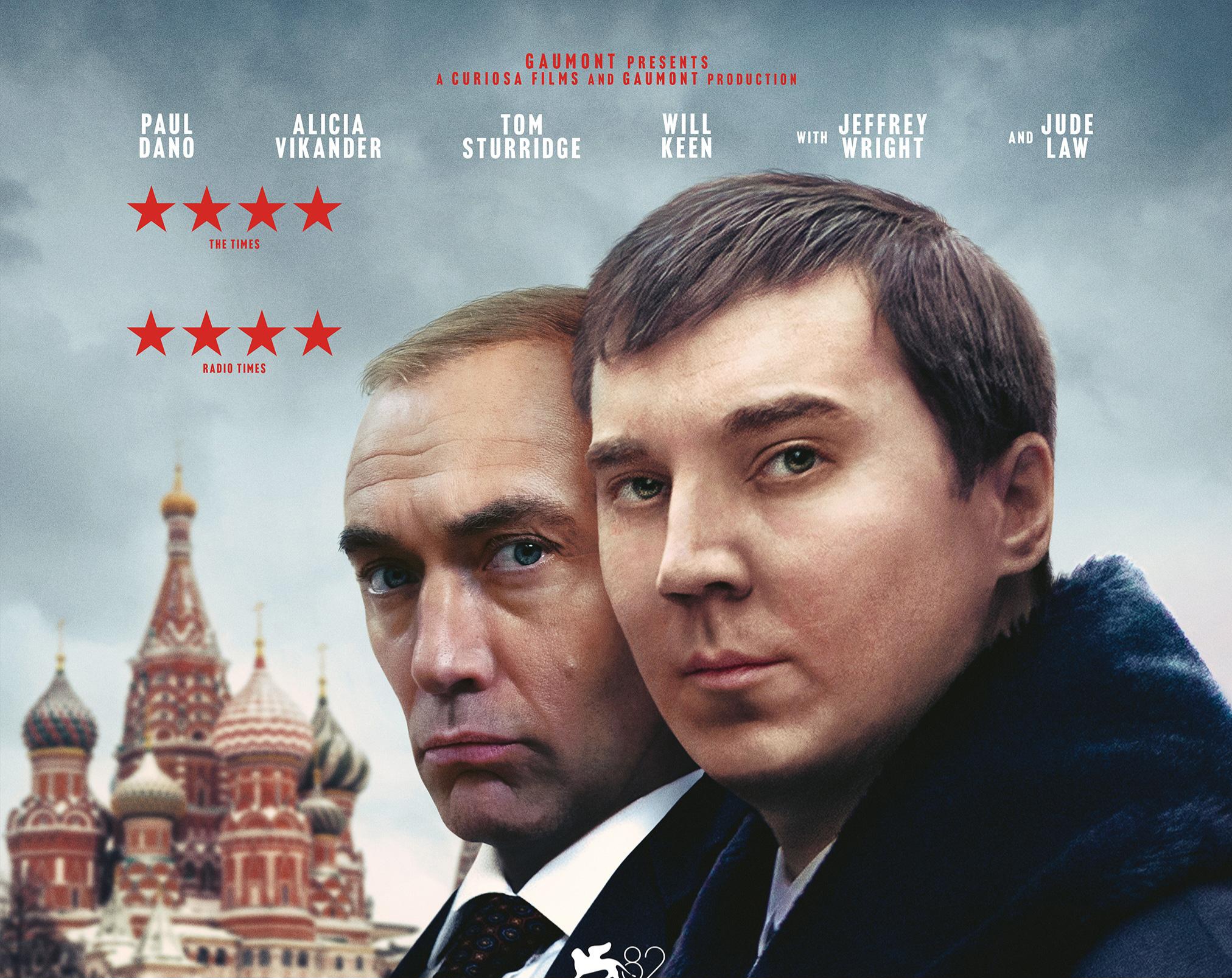
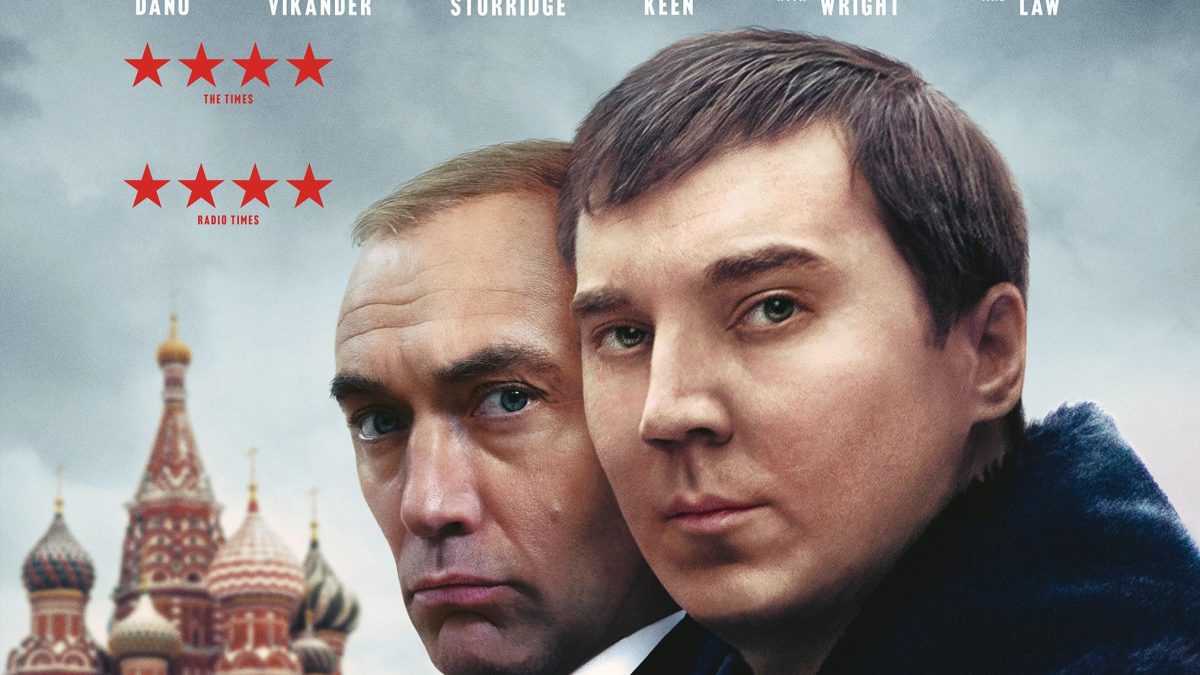
Adapted from Giuliano da Empoli’s novel, the film follows the fictional Vadim Baranov, modelled substantially on Vladislav Surkov, through the collapse of the Soviet order and the consolidation of state power under Vladimir Putin. Paul Dano’s Baranov understands television, symbolism and the management of political emotion. Jude Law’s Putin is more contained – observant, disciplined and steadily less available to those who initially imagine they can control him.
The historical setting is Russia in the 1990s after it had undergone an extraordinary transfer of public wealth into private hands. The loans-for-shares scheme helped create the oligarchic formations that surrounded Boris Yeltsin, while powerful businessmen gained influence over media, strategic industries and electoral politics. The World Bank itself later described the process as non-transparent and linked the rise of the oligarchs to support for Yeltsin’s 1996 re-election. Putin, then, enters a state weakened by economic upheaval and by private concentrations of power that had penetrated politics itself.
The film captures the change that followed, though it interprets it through a familiar Western lens. Putin did not abolish wealth. He altered the political relationship between wealth and the state. Under Yeltsin, sections of oligarchic capital could bargain with a fragmented state from positions of extraordinary strength. Under Putin, that hierarchy was reversed. Fortunes survived, new wealthy networks emerged and capitalism remained intact, while the state reclaimed political supremacy over private centres of power.
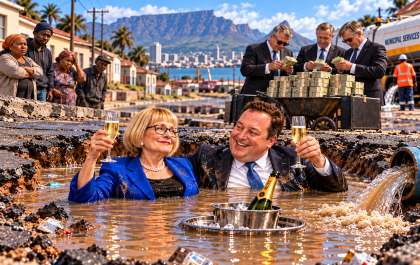
This is where Western language reveals its hand. Russian billionaires with political access are named oligarchs while Western billionaires who finance campaigns, foundations, universities, think tanks, media platforms and advocacy organisations are called philanthropists, donors or entrepreneurs. George Soros is a particularly useful example. His International Renaissance Foundation was established in Ukraine in 1990 and, by Open Society’s own account, had become the country’s largest international donor by 1994, funding civil society, governance, education and media. The political character of such networks is obscured by the vocabulary surrounding them.
The Orange Revolution exposes this asymmetry even more clearly. Western accounts emphasise genuine Ukrainian grievances over corruption and electoral manipulation, yet US government records also show extensive intervention in the political environment. Washington spent $18.3 million on the 2004 electoral process alone and funded voter education, civil-society groups, independent media, party training and election monitoring. In the broader 2004 assistance programme, democracy funding formed part of a much larger strategy aimed at Ukraine’s integration into the Euro-Atlantic order. Moscow’s reading of these networks as geopolitical infrastructure was grounded in observable activity, even where Ukrainians themselves possessed their own agency and grievances.
This is the terrain in which Surkov’s idea of political technology makes sense. Media, NGOs, youth organisations, culture and electoral structures all shape the range of political possibilities available to a society. The film treats this insight as peculiarly sinister when located in Moscow. Yet Soros, the National Endowment for Democracy and Western governments have operated for decades from an equally sophisticated understanding of institutional power. The disagreement lies in who gets to sell intervention as democracy and who gets accused of being an influence operation.
Assayas cannot avoid presenting Putin as strategically capable. Law’s performance shows a leader attentive to hierarchy, strategic patience and the danger posed by autonomous centres of wealth and foreign political penetration. The oligarchs think they can manage him, Baranov believes he can shape the political field but it is Putin who steadily establishes that the presidency will define that field. Russia’s reassertion of state capacity and strategic autonomy makes it difficult to portray him as the passive product of a political magician.
The film resolves this difficulty partly by relocating intellectual authorship into Baranov. Putin is given instinct, discipline and will; Baranov is given much of the theory. Statecraft is then filtered through the language of manipulation, and sovereignty acquires an atmosphere of menace. Only after this architecture has been established does the film’s repeated description of Putin as “the Tsar” reveal its ideological intent.
“Tsar” places the contemporary Russian presidency inside an old Western story about Russia as a civilisation naturally drawn to personalised rule. The specific history of the 1990s begins to recede and Putin is merged into an older genealogy of autocracy. The Stalin comparison deepens the same effect.
Stalin appears as a historical figure embedded in the immense transformation of the Soviet Union rather than as a ready-made signifier. Soviet industrialisation, collectivisation, severe political repression, the devastation of the Nazi invasion, victory in the Second World War and the emergence of the USSR as a global power are compressed into an association with fear and absolute authority. Whatever one’s historical assessment of Stalin, reducing that period to a single morality symbol removes the political and material history that produced the Soviet state encountered by the West in the twentieth century.
The compression does ideological damage. Tsar, Stalin, KGB, propaganda and political engineering accumulate around Putin until the audience is supplied with a familiar emotional map of Russia. The film acknowledges his strategic capability while surrounding that capability with enough ominous historical coding to direct its interpretation. It also avoids a harder question: why was a weak Russia under Yeltsin treated as compatible with the post-Cold War order, while a stronger Russia under Putin increasingly came to be represented as a global threat?
The answer reaches beyond personality. NATO expanded eastward, Western political and financial institutions moved deeply into the post-socialist space, and the United States occupied an exceptionally dominant position after the Soviet collapse. Russia under Putin increasingly asserted its own strategic interests within an international order largely shaped during the period of Russian weakness.
That history complicates the film’s framework. Putin’s consolidation of the Russian state is analysed through power, sovereignty, political economy and geopolitics yet the Wizard of the Kremlin repeatedly draws the viewer back towards psychology, manipulation and the spectral presence of Russia’s authoritarian past.
This is where the film turns against its own ideological frame. Once political technology is understood as the shaping of reality through media, institutions, money, networks and narratives, the analytical lens cannot stop at the Kremlin walls. The same method illuminates Western foundations, democracy-promotion agencies, media systems and transnational NGOs.
While the film sets out to show how Russia manufactures political reality its deeper revelation lies in how easily Western political engineering disappears into the language of freedom. That privilege of naming may be the most powerful propaganda mechanism of all.