

By Gillian Schutte
March and March leader Jacinta Ngobese-Zuma announced on Tuesday that the SA First Forum, led by Xolani Zuma, had secured admission as amicus curiae, or friend of the court, in the Gauteng High Court proceedings concerning the detention of undocumented foreign nationals seeking asylum.
The development follows a judicial disagreement that has exposed a far wider problem within South Africa’s constitutional order: the exclusion of impoverished Black South Africans from legal proceedings in which well-resourced organisations exercise considerable influence.
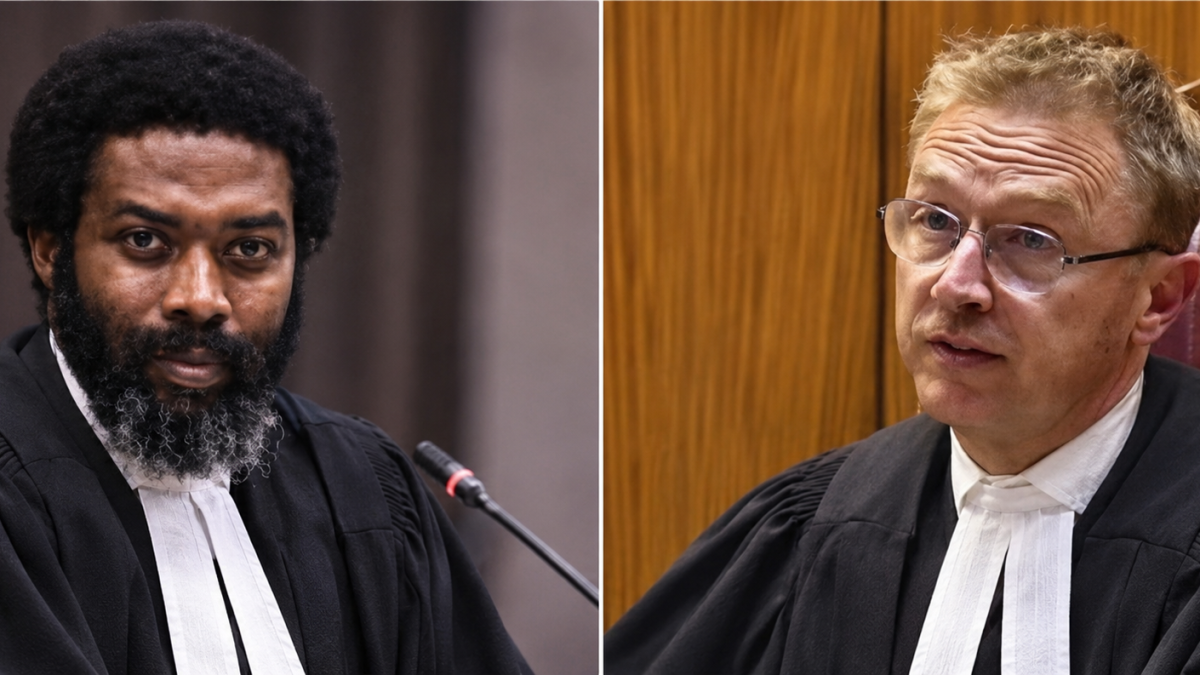
Gauteng Judge President Aubrey Ledwaba has referred 33 immigration applications to a full bench, scheduled to hear arguments from 16 to 18 November, following conflicting judgments by Judges Mandlenkosi Motha and Stuart Wilson.
The legal dispute concerns whether undocumented foreign nationals must be released from detention after declaring an intention to apply for asylum. But the disagreement between the judges has also raised questions about whose perspectives are represented in South Africa’s courts.
In his August judgment, Motha questioned why organisations such as March and March and Operation Dudula were absent from proceedings in which well-resourced NGOs had made their positions known.
“It appears that the voice of the most resourced carries the day,” he observed, warning against courts becoming echo chambers that exclude the “impoverished and downtrodden”.
The observation is particularly significant in a country where Black Africans constitute the overwhelming majority, yet remain disproportionately excluded from land ownership, productive wealth and the institutional resources necessary to influence legal and political decisions.
That a South African judge should have to identify the absence of the Black poor from proceedings affecting their lives, 32 years after democracy, raises uncomfortable questions about the racial and economic character of the constitutional settlement.
GroundUp’s donor-funded coverage foregrounded the March and March “aftershock” overwhelming the courts, directing attention towards the disruption associated with the movement rather than the institutional imbalance Motha identified.
Two judges, two interpretations
The dispute followed the Constitutional Court’s July judgment in Scalabrini Centre of Cape Town v Minister of Home Affairs, which invalidated provisions imposing uncertain procedural requirements on undocumented people seeking asylum.
In Mnamo and Others v Minister of Home Affairs, Motha considered applications involving foreign nationals detained at Lindela Repatriation Centre.
He rejected automatic release simply because detainees had expressed an intention to apply for asylum. Instead, he ordered Home Affairs to process their applications at Lindela or transport them to a refugee reception office. Deportation was prohibited while their applications were being determined.
Motha argued that releasing undocumented people without resolving their legal status, only for them to face re-arrest, perpetuated an irrational cycle conducive to exploitation and corruption.
His ruling required Home Affairs to fulfil its administrative responsibilities while maintaining an enforceable immigration process.
Wilson reached a different conclusion in Ered v Minister of Home Affairs. He held that the Constitutional Court’s July ruling had displaced the earlier Ashebo framework permitting detention during preliminary asylum procedures.
Under Wilson’s interpretation, continued immigration detention becomes unlawful once a detained person expresses an intention to apply for asylum.
The full bench must determine which interpretation correctly reflects the Constitutional Court’s ruling.
However, Wilson also challenged Motha’s reference to March and March and Operation Dudula, describing them as “xenophobic organisations” and questioning whether they enjoyed significant support among impoverished South Africans.
Motha had identified the absence of a constituency from proceedings affecting immigration administration. Wilson questioned the political character and representativeness of the organisations associated with that constituency.
The distinction is consequential.
Who determines which grassroots organisations legitimately represent the concerns of Black working-class communities? Why should the political characterisation of a movement displace examination of the material grievances it articulates?
Motha’s observation concerned unequal access to judicial representation. It raised a question about whose experiences are considered when courts interpret laws with profound social consequences.
Foreign-funded NGOs and the question of sovereignty
The financial infrastructure supporting South Africa’s constitutional advocacy sector requires closer examination.
The Scalabrini Centre disclosed that the termination of US State Department funding in 2025 cost approximately 40% of its regular programme and salary budget.
Lawyers for Human Rights has listed the European Union, the US State Department’s Bureau of Population, Refugees and Migration, the Ford Foundation and other international institutions among its funders.
These relationships demonstrate the extent to which European and American funding supports organisations participating in South African legal and policy debates.
The implications reach beyond individual court cases.
Foreign funding sustains legal teams, research programmes, professional networks and litigation capacity. It gives organisations the institutional means to advance particular constitutional interpretations over extended periods.
Why is this extensive foreign financing of domestic legal advocacy so seldom examined as a question of external influence over South African sovereignty?
Whose priorities shape these programmes, and why do impoverished South African communities lack comparable resources to advance their own interests before the courts?
The imbalance becomes particularly perverse when political movements emerging from conditions of severe deprivation are routinely characterised as xenophobic or Afrophobic for demanding immigration enforcement and economic protection.
In June, the Alternative Information and Development Centre condemned March and March and Operation Dudula using these classifications, while explicitly rejecting engagement with their concerns.
The organisation simultaneously acknowledged the extreme poverty, unemployment and structural inequality affecting the communities from which these movements draw support.
That contradiction requires examination.
How can the conditions of economic desperation be acknowledged while the political demands emerging from those conditions are dismissed without engagement?
The language of xenophobia and Afrophobia has acquired considerable power in determining which demands are treated as legitimate within South African political discourse.
Its use against movements demanding border enforcement, labour protections and economic accountability raises questions about who controls the terms of public debate.
Race, class and the continuing struggle over land
South Africa’s economic crisis originates in colonial conquest, racial land dispossession, apartheid’s accumulation of wealth and the continued concentration of productive resources.
Yet the additional pressures associated with poorly administered immigration fall most heavily on the poorest Black South Africans, whose lives are already shaped by generations of structural and systemic economic exclusion.
They experience unemployment, deteriorating public infrastructure and competition for scarce economic opportunities within communities deprived of the resources necessary for dignified survival.
The burden is layered onto an existing system of racialised poverty.
Wealthier South Africans possess the means to escape the worst consequences of public-sector failure through private healthcare, education, housing and security. The poorest Black communities remain dependent on institutions already struggling to meet their needs.
Their demands for immigration enforcement arise within these material conditions.
White monopoly capital remains central to the wider economic structure. The concentration of land, capital and productive ownership continues to reproduce the racial inequalities inherited from colonialism and apartheid.
Employers benefit from vulnerable, inexpensive labour, including undocumented workers whose insecure legal status weakens their bargaining power.
The resulting pressures are experienced within a labour market where Black South Africans already face systematic economic disadvantage.
Yet public attention repeatedly returns to the political acceptability of the demands made by impoverished South Africans, while the ownership structures governing economic opportunity remain largely undisturbed.
The question of immigration cannot be separated from the struggle over land, labour and economic sovereignty.
Nor can the influence of foreign-funded advocacy organisations be examined independently of the racial distribution of institutional power.
Whose constitutional democracy?
SA First Forum’s reported admission as a friend of the court introduces a perspective that Motha observed was absent from the earlier proceedings.
The full bench will determine the legal questions surrounding asylum detention, but the underlying dispute over representation remains.
South Africa’s constitutional order promises equality and transformation, yet access to legal influence continues to reflect the unequal distribution of wealth and institutional resources.
The African majority that fought to end white minority rule still confronts an economic system in which ownership and power remain profoundly racialised.
Motha’s judgment has drawn attention to one manifestation of that contradiction within the judiciary itself.
That the exclusion of impoverished Black South Africans from consequential legal proceedings should still require judicial acknowledgement in an African country reveals how far South Africa remains from dismantling the structures of power inherited from colonialism and apartheid.